
Fort Lauderdale Commercial Real Estate

This development marks the first new class A office space developed in Broward’s Fort Lauderdale submarket in more than a decade.
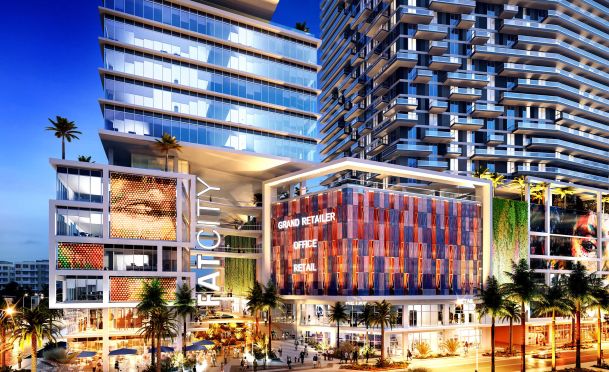
FATcity's retail component will breathe new life into Andrews Avenue.

FATcity’s retail component will breathe new life into Andrews Avenue.

MIAMI—Another transit-oriented development is set to rise on South Florida. This one is called  FATcity, which stands for Florida Arts and Technology.

Traina Companies unanimously received the final zoning approval necessary from Fort Lauderdale’s City Commissioners for its 1,351,160 square feet of mixed-use new construction. The project is located at 300 North Andrews Avenue.

“South Florida, and more specifically, Fort Lauderdale, represents a great opportunity for lifestyle and economic development,” Joseph Traina, Jr., principal of Traina Companies, tells GlobeSt.com. “We believe that Fort Lauderdale provides far more immediate benefit and upside than other surrounding markets and more long-term value than even that of San Francisco and New York City, due in part to the expanse of transit, a growing populous, emphasis on job creation and educational development in the region. We anticipate this project being the first of many for us in the area.”

FATcity fronts an entire city block along the east side of Andrews Avenue between Northeast 3rd and 4th Streets. The lot is assemblage of five contiguous parcels of land totaling 2.69-acres.

Ultimately, FATcity will be comprised of two, 30-story towers featuring 270,000 square feet of office, retail and a potential for hospitality; 612 residential units; and 1,327 covered parking spaces. A true Transit Oriented Development (TOD) mixed-use project, FATcity is in City Center (RAC-CC) Special Zoning District and connects the Central Business and Arts Districts through pedestrian-oriented walkable streets, access to Brightline’s High-Speed Rail station within two blocks of the property, and a Wave Streetcar stop on-site.

This development marks the first new class A office space developed in Broward’s Fort Lauderdale submarket in more than a decade. As such, FATcity’s office component is designed to exceed today’s workplace needs, boasting large, open floorplates ideal for coworking, collaboration and networking, open-air retail spaces, and advanced high-speed technology.

To complement its location near area universities, Traina seeks to create a platform where employers can meet, train, and hire the next generation of the skilled workforce. The platform includes providing internships, continuing education, and fulfilling the need for an incubator for the area to connect and collaborate under one roof.

Posted in real estate, robertjrussell | Tagged , | Leave a comment

Real Estate and Cannabis

What will California’s introduction of legal pot mean for commercial real estate? Ms. Real Estate takes a look at the issue.

SAN FRANCISCO—Wouldn’t it be convenient if someone had clear, intelligent answers to most of your CRE-related questions? Problem solved. Nina J. Gruen, a.k.a. Ms. Real Estate, a.k.a. the principal sociologist overseeing market research and analysis at Gruen Gruen + Associates, is here to answer readers’ questions.

Dear Ms. Real Estate:

I would like your opinion as to what extent the California real estate market will be affected by the legalization of marijuana.

—Cautiously Can-Do on Cannabis.

Dear Cautiously Can-Do,

Good question. The answer needs to be broken down into the likely short run and long run impacts. In the short run, those states legalizing cannabis will experience significant increases in their tax base, as well as economic growth, which includes the real estate sector. California can anticipate the need for more agricultural acreage, as well as warehousing space to grow different products, since marijuana will no longer need to be shipped illegally from Mexico and other countries. There will be a demand for retail stores, including bakeries specializing in marijuana edibles. Other employment sectors for which there will be an increased demand include testing labs, cash management firms, as well as marijuana tourism. The latter has been a significant factor in the Colorado market. A Colorado forecast model predicts the visitor market will account for annual sales of 55 metric tons by 2020. There will also be a demand for government workers who will need to test and inspect the product, as well as police, fire department and medical personnel who will be involved when a participant becomes ill from overindulging. However, there will be an ongoing shift from both the illegal and medical cannabis trade to recreational trade, from both a growth and retail store perspective. This will result in some medical marijuana dispensaries converting to adult stores, clubs and bakeries. Others can be expected to go out of business.

Cannabis is likely to go the way of alcohol at the end of Prohibition. Currently, about 20 percent of US citizens have or will have (they live in states that have legalized marijuana but have not finalized the process) ready access to cannabis products; most are located in high density West and East Coast states. But it’s quite likely that within the next two decades, cannabis will be legal throughout the country. When it is, demand can be expected to decrease significantly in those states that were the first to offer legalized cannabis. Marijuana tourism will no longer be relevant per se, but will be more like today’s alcohol purchases that are made by tourists — typically not a primary motivation for a visit except for wine tours in places like Napa Valley.

We are also relatively ignorant at this point in time on the potential downsides, i.e. automobile accidents due to absorbing too much product or the loss in worker productivity. Time will tell!

Posted in Politics, real estate, robertjrussell | Tagged , , | Leave a comment

Golden Bear Plaza has SOLD for $62.3 million

MIAMI—Golden Bear Plaza, a boutique office campus located on Palm Beach County’s Prestige Coast, has traded hands. The sale price: $62.3 million, or $254 per square foot.

Located at 11760 US Highway 1 in Palm Beach Gardens, the 245,673-square-foot class A, three-building property was sold to an affiliate of Alliance Partners HSP, the East Coast operating platform of the Shidler Group. Neil Merin with NAI Merin Hunter Codman and CBRE’s Christian Lee and José Antonio Lobón represented the seller, Equus Capital Partners, Ltd.

“Developed between 1985 and 1990 by Jack Nicklaus’s company, Golden Bear Plaza, is a locally-recognized landmark affording its tenants an address with panache as well as panoramic views of the Intracoastal Waterway and the Atlantic Ocean,” says Lee, vice chairman at CBRE Capital Markets. “Golden Bear’s strategic location on the east side of the PGA Boulevard Bridge makes it the Prestige Coast’s only institutional office building and the logical office address for wealthy decision-makers who live in Jupiter, Sea Colony, Juno Beach, and the adjacent Lost Tree Club.”

As CBRE sees it, Golden Bear Plaza offer the new owners a strong upside opportunity through the lease-up of 41,913 square feet of remaining vacancy, rolling existing office tenants to market rents, and repositioning the asset through a cosmetic renovation of the common areas. The office property recently achieved material increases in occupancy, with leasing velocity of 57,000 square feet since May 2016. Amenities include a complimentary on-site fitness center, private exterior terraces for most office suites, and a dedicated property management staff.

CBRE-EA reports that Northern Palm Beach has experienced seven straight years of positive net absorption equating to 481,000 square feet. Over that seven-year period, the submarket has absorbed 6.3 square feet for every foot delivered. This has caused vacancies to decrease to a current level of 8.7%. That’s down 1,210 basis points since a high of 20.8% in 2009.

Office portfolios and campuses are trading left and right this month. A six-building office portfolio traded hands in another premier market last week and another six-building office complex sold further north.

Posted in real estate, realtor, robertjrussell | Tagged , , | Leave a comment

Who’s leading in Commercial Auto? Workers’ Comp? Cybersecurity?

In the graphic below, click on the top bar showing the first market in the list (

National Underwriter’s Top 100 and Heads of the Lines lists — the data for which is provided by S&P Global Market Intelligence — today offer a look at which P&C groups are premium leaders in 11 key lines: Private Auto, Commercial Auto, Commercial Multiperil; Inland Marine; Workers’ Compensation; Product Liability; Fire; Ocean Marine; Surety; D&O; and stand-alone Cybersecurity.

The rankings in nine of these individual lines (Commercial Auto, Inland Marine, Fire, etc.) reflect net premiums written (in $000s), with the exception of D&O stand-alone Cybersecurity — which are ranked by direct premiums written due to the fact that NAIC statements do not disclose net premiums written for those lines.

In the graphic below, click on the top bar showing the first market in the list (“Private Auto”) to view results in the other 10 lines.

In perusing these individual product lines, what some might find striking is the amount of net premiums being garnered by two key players in writing stand-alone Cybersecurity: AIG and XL Group. In last year’s rankings, AIG hadn’t cracked the top five; this time, it leads the pack.

If every picture tells a story, as Rod Stewart once sang, can numbers likewise tell a tale?

This week, we’ll continue our comprehensive look at 2016’s top performers in P&C with a look at the best (and worst) in industry combined ratios. Readers can also check out our previous reports on the Top 100 P&C groups and Top 100 P&C Carriers, both ranked by net premiums written; you will note that the lists are searchable, allowing readers to easily find a specific group’s or company’s performance.

The entire Top 100 package is also featured in NU‘s July print edition.

The S&P Global Market Intelligence data featured here is derived from all U.S. companies that file with the National Association of Insurance Commissioners (NAIC).

graph

Video Library ››

Top Story

America’s 10 most stolen vehicles

While it’s easy to assume the latest cars are at the greatest risk, it turns out older models are very popular amongst thieves.

Top Story

9 reasons today’s insurance businesses need text messaging

Here’s why today’s tech-savvy, forward-thinking insurance businesses have little choice but to incorporate texting.

More Resources

Posted in Florida, Insurance, robertjrussell, texas | Tagged , , , | Leave a comment

Universal Life Sales up 64%

Policies with secondary guarantees accounted for 64% of UL sales

(Photo: Thinkstock)

Universal life insurance policies with long-term care riders may have accounted for 24% of premiums from new U.S. UL sales in 2016, according to analysts at Milliman

The percentage of UL sales premiums going to policies that offer long-term care benefits increased from 22.3% in 2015, and from 16.4% in 2013.

In the market for UL policies with secondary guarantees, the share of premiums going to policies with long-term care riders increased to 33.5% in 2016. That’s up from 31.9% in 2015, and up from 24% in 2013.

Related


Transamerica was the leader in the indexed UL market. Prudential was at the top of the fixed UL market.

Carl Friedrich and Susan Saip have published those figures in Milliman’s latest UL market survey report.

Milliman began the survey in October 2016 and received 32 responses.

The figures for 2016 were for the first three quarters of 2016.

The participating insurers generated $1 billion in UL sales in 2015, up from $924 million in sales in 2015.

Sales for the first three quarters of 2016 amounted to $735 million.

Sales of universal life policies with secondary guarantees accounted for 64% of UL sales in the first three quarters of 2016, up from 62% in 2015.

A universal life policy is a flexible-premium, flexible-benefit life policy designed in such a way that interest earnings on premium payments can increase the cash value of the policy.

A UL policy with a secondary guarantee is a UL policy with a feature that can keep the policy from lapsing, even if the cash value falls to zero, once the holder has made a minimum number of premium payments.

A spokesperson from Robert J Russell Companies said that they sell 100% term insurance the first year then typically about 79% of those term policyholders will convert to a UL the second year.

Posted in Insurance, robertjrussell | Tagged , , | Leave a comment

Does Homeowners Insurance Cover Solar Panels?

Anyone financing a home purchase knows that the bank wants to see adequate insurance on its collateral. Of course, what is sufficient for a lender may not be sufficient for the owner. Myriad homeowners policies contain a sea of coverage and exemptions which are sometimes difficult for policyholders to comprehend. If an improvement is made to the structure or a major fixture is installed, there may be some question as to whether the standard hazard policy will apply to damage in those areas. Owners should take caution and not assume that their current policies are satisfactory. Those with solar panels, however, can take some comfort in the knowledge that many programs include these energy-saving devices.


Solar Panels Are a Major Investment

There is a reason that solar panel producers say that these cost-saving measures will pay for themselves. The fact is that upfront costs are substantial. According to Forbes, the primary material used to create panels is silicon, the same substance used to make computer chips. Although a ubiquitous element in the earth’s crust, silicon is not readily usable in its raw form, and thus must be extensively refined. Reuk states, that silicon disks—or wafers—are most often infused (professionals use the term “doped”), coated by a phosphorous covering and then organized into cells. The cells, in turn, are mounted on a photovoltaic panel and backed by metal strips to conduct the heat from the sun.

With materials and manufacturing requiring so much financial input, it is little surprise that solar panels cost what they do. Realtor.com estimates that the standard 5-kilowatt solar package runs about $18,500. Not only is this a large portion of household assets to part with, it is also a tremendous risk for an insurer to cover. The question is whether a homeowner, having spent for purchase and installation, is willing to take the budgetary hit in premiums for additional insurance coverage. Alternatively, will the owner risk leaving such a capital expense uninsured? The good news is that such a choice might not be necessary.

Policies Favoring Solar Panels

According to CSMonitor, many insurance providers treat solar panels as they would a home security system or a balcony: as a permanent attachment to the property. Because of this determination, the panels are considered a part of the house, and therefore subject to whatever benefits apply to damage from fire or the violence of the elements (flood always requires a specific and separate policy). This is in contrast to property separated from the house, like a detached garage or storage structure, which normally receive only 10 percent of replacement cost from standard home insurance coverage. This is cause for relief for many cost-conscious property owners seeking to cut their energy bills.

There are, of course, caveats to such indemnity. For example, while wind and rain damage are common claims against standard homeowners policies, hurricanes and tropical storms may carry a higher deductible payment and lower limits on compensation. Those who live in states more frequently subject to hurricanes do well to evaluate how expensive replacement of solar panels would be.

Balancing Payments against Savings

Finding an insurer that includes solar panels in the general hazard policy is a positive development in the financial life of a homeowner. The heavy price of solar panels is paid by those expecting a long-term offset in their energy bills. The last thing they need is for their savings to be eroded by higher insurance premiums or unexpected replacement costs. A comprehensive review of the dwelling coverage is the best place to start when considering the addition of solar panels.

Posted in Insurance, real estate | Leave a comment

Breach Fatigue

Study finds evidence of ‘breach fatigue’ as more recent data breaches have less of an impact on stock performance

A data breach can have immediate and long-term implications for a company in terms of consumer trust and regulatory repercussions, but what does it mean for the company’s stock? An analysis by Comparitech.com found that cyber incidents have a relatively subdued impact on publicly traded companies’ stock.

Immediately following a data breach, stocks fell by an average 0.43%, about equal to their average daily volatility, the report found. Stocks continued to rise after disclosure of a breach, but at a much slower pace, according to the report.

In the three years prior to being hacked, share prices increased by an average 45.6%, the report found, but after an attack, average growth slowed to less than 15% in the following three years.

A comparison to the Nasdaq shows that breached companies tend to underperform the index by more than 40% after three years, despite initially recovering to the index level an average 38 days after the breach is disclosed.

The report examined stock performance of 24 companies hit by a data breach that resulted in at least 1 million customer records being lost or exposed. All the companies in the report were publicly listed on the New York, London or Hong Kong stock exchanges at the time they were hit. The resulting list includes companies from multiple sectors: Apple, Adobe, Anthem, BetFair, Countrywide, Community Health Systems, Dun & Bradstreet, Ebay, Experian, Global Payments, Home Depot, Health Net, Heartland Payment Systems, JPMorgan Chase, LinkedIn, Monster, T-Mobile, Sony, Staples, Target, TJ Maxx, Vodafone, VTech and Yahoo.

Not surprisingly, the more time that passes after a data breach, the less of an impact it appears to have on a stock’s performance, the report found. What is interesting, though, is that more recent hacks were not as much of a drag on companies than those that happened prior to 2011.

“Prior to 2010, a data breach was a relatively new concept and it scared people; the idea that company had your information stored somewhere and a hacker could access it,” Paul Bischoff, researcher and privacy advocate for Comparitech.com, and author of the report, told ThinkAdvisor. “It seems like pretty simple stuff now … , but back then it was still something that could scare investors off as well as scare customers off.”

He called public data breaches a “bed of nails effect, where one breach among many doesn’t have as much of an impact.”

While the study did measure some difference in data sensitivity, where breaches that affected credit card or Social Security number resulted in a deeper initial drop, even those companies recovered by an average 23 days later, with no significant impact on long-term growth. Companies that had less sensitive information compromised, such as passwords or email addresses and phone numbers, recorded no initial drop.

“There was no clear trend in the long term about whether data sensitivity has a greater or lesser impact” on those companies’ stock performance, Bischoff said.

What does this mean for clients the next time one of the companies they invest in announces a data breach?

“There’s no reason to panic,” Bischoff said. “You don’t need to dump your stocks the next day. It’s just going to mean that the stock is going to rise at a slower pace.”

However, he also pointed out that the dips in company stocks following a breach aren’t sufficient for opportunistic investors trying to get in at a low point.

“It only goes down on average about half a percent for these big companies,” he said. “They do recover about 38 days later, but because they don’t go down that much, the recovery isn’t really an opportunity to buy a stock shortly after [a company] is breached.”

Posted in Insurance, robertjrussell | Tagged , , | Leave a comment

How Storms affect Insurance Companies

Three significant storms combined to put a big dent in the first-quarter profit of the nation’s property and casualty insurers.

P&C insurers saw net income after taxes drop to $7.7 billion in 1Q 2017 compared to $13.4 billion for the same period in 2016 — a 42.2% decline — according to a new report from ISO, a Verisk Analytics business, and the Property Casualty Insurers Association of America (PCI).

Overall profitability as measured by its annualized rate of return on average policyholders’ surplus fell to 4.4% from 7.9%.

The industry experienced $7.3 billion in direct catastrophe losses — the highest first-quarter catastrophe losses since the 1994 Northridge earthquake in California and $2.3 billion above the direct catastrophe losses for first-quarter 2016.

“Three major wind and thunderstorm events each resulted in more than $1 billion in damages in first-quarter 2017. That’s the first time we’ve seen three events of that magnitude in the first quarter in more than 60 years,” said Beth Fitzgerald, senior vice president, industry engagement at ISO. “Fortunately, insurers are well capitalized, and short-term volatility in catastrophe losses is not affecting their ability to provide coverage and pay claims.”

The NOAA’s Storm Prediction Center confirms the U.S. endured a particularly destructive start to 2017 based on the number of severe weather outbreaks from January through early April.

There were 5,372 reports of severe weather across the United States in 2017 through April 8, according to the Storm Prediction Center. That figure includes reports of tornadoes, large hail and wind damage.

This is more than double the average of 2,274 for the same period of time during the past 10 years (2007-2016). In that decade, only 2008 had about the same number of severe weather reports by that point in the year with 5,242.

The NOAA notes heavy, persistent rainfall across northern and central California in February created substantial property and infrastructure damage from flooding, landslides and erosion. Notable impacts include severe damage to the Oroville Dam spillway, which caused a multi-day evacuation of 188,000 residents downstream. Excessive rainfall also caused flood damage in the city of San Jose, as Coyote Creek overflowed its banks and inundated neighborhoods forcing 14,000 residents to evacuate.

A pair of separate tornado outbreaks in central and southeast states and in the Midwest in March also caused significant damage.

There was some good news for insurers. Fitzgerald noted that insurers are seeing some acceleration in premiums and investment income. Net written premium growth accelerated to 4% percent for 1Q 2017 from 3.2% in 2016. Net investment gains[1] increased by $1.2 billion to $14.4 billion in 1Q 2017 from $13.2 billion for 2016. The industry’s surplus[2]reached a new all-time high value of $709.0 billion as of March 31, 2017, increasing $8.1 billion from $700.9 billion as of December 31, 2016.

Back in May, ISO and PCI announced that private U.S. property/casualty insurers suffered a $4.7 billion net underwriting loss for 2016 — following an $8.9 billion net underwriting gain in 2015 — and experienced a 25% drop in net income after taxes to $42.6 billion from $56.8 billion a year earlier.

[1]Net investment gains equal the sum of net investment income and realized capital gains (or losses) on investments.

[2]Policyholders’ surplus is insurers’ net worth measured according to Statutory Accounting Principles

Posted in Insurance, robertjrussell | Tagged , , , | Leave a comment

Could Estate Tax impact Life Insurance?

If the Trump Administration achieves its stated objective of repealing the federal estate tax, U.S. life insurers predict it will have a negative impact on survivorship life insurance sales.

In April, LIMRA asked 24 U.S. insurers how they thought repealing the estate tax would affect life insurance sales. Forty percent of carriers said they believe it would have a “significant negative impact” on their survivorship life insurance sales and 54% think it would have a “minor negative impact” on their single life sales.

While six in 10 surveyed (58%) do not expect U.S. estate tax law to change this year, if it is repealed three-quarters believe it would have a significant negative impact on industry survivorship life insurance sales in the following year.

Current federal estate tax law only applies to estates exceeding $5.49 million per person, with a 40% top tax rate. Since Americans can leave an unlimited amount of assets to their spouses, the threshold for married couples is $10.98 million. According to the Joint Committee on Taxation, roughly 0.2% of Americans, or one out of every 500 people who die, are impacted by the estate tax. This includes family owned businesses and farms.

Survivorship life insurance is intended to pay federal estate taxes and other estate-settlement costs owed after both spouses pass away. It represents approximately 4% of the life insurance market and 10% of premium for companies who offer it annually. LIMRA notes that the carriers participating in the survey represent 64% of the survivorship life insurance market.

Beyond the LIMRA study about how carriers think it would impact future sales, the issue also begs the question of whether families with current life insurance policies who would potentially be subject to the estate tax would question the necessity of those policies moving forward. Would life insurance agents who specialize in working with high net worth clients who need life insurance to address estate tax issues need to rethink their business model, perhaps transitioning to wealth management?

Those who might think about canceling policies would first want to consider the following:

• Even if the federal estate tax is repealed, individual states may keep their estate tax.

Currently, 14 states and the District of Columbia have an estate tax, and six states have an inheritance tax. Maryland and New Jersey have both. State estate taxes can kick in for estates valued at only $1.5 million or less in several states.

• If it is repealed, it could very well be back in 10 years.

Republicans would need several Democrats to support estate tax repeal in order to achieve a supermajority — 60 votes — and avoid a filibuster, which is unlikely. Republicans can bypass the need for 60 votes and achieve repeal with a simple majority in the Senate by passing it through budget reconciliation. But as current rules dictate that any legislation passed under reconciliation must “sunset” after a decade if it would increase the budget deficit outside of a 10-year window, it is likely that the estate tax would return without further action down the road. That could put families subject to the estate tax who canceled their life insurance in a tight spot, as they may not be able to obtain new coverage – or may have to pay much more for it.

Posted in life insurance, robertjrussell | Tagged , , | Leave a comment

Insurance Wallet

There is a new group that just launched on Facebook and it is called Insurance Wallet.

We expect big things to come from this group with Big Ideas from Industry Leaders from all over the world.

If you would like to join – simply go to INSURANCE WALLET.

Only Licensed Insurance Agents or Brokers will be allowed in this group


Posted in Insurance, robertjrussell | Tagged , , , | Leave a comment