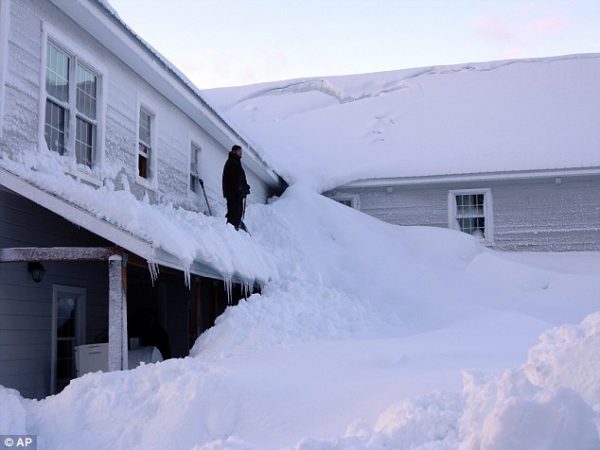
Are you excited for snow season yet?

article-2085892-0f6251cf00000578-622_634x476-600x450

Ah, winter! The time of cozy fires, big ole mugs of hot cocoa, and—for those of us living in frosty climates—hours upon hours of shoveling snow.

Whether it’s laziness or forgetfulness, not clearing your home of snow in a timely fashion can create a bevy of problems, from a cracked foundation to a flooded basement or a slippery driveway that leads to a lawsuit from your irritable postal service employee.

Just for a fun little winter pregame, here is a selection of homes absolutely smothered in snow. Sit back and prepare to pity these homeowners.

Posted in real estate, robertjrussell | Tagged , , , | Leave a comment

Hero and First Saint of the Life Insurance Business

Heroes are an important part of culture and civilization. Heroes stir the imagination of the mind and motivate the romance of the soul. A world without heroes would be a colorless and drifting world. Leaders study heroes. A knowledge of the past and the handling of crisis by heroes helps determine the plan of action for the battles and problems of today.

Knute Rockne, the famous football coach, always took his team back to basics after each game. John Wooden, the legendarExecutive Heroy UCLA basketball coach, never concerned himself with the competition. He only prepared himself and his team to do the very best they could, at all times.

The Life Insurance Industry has serious problems confronting it. The companies and the agents are faced with a challenge for survival. A recent LIMRA study of MDRT members exposes the fact that our best producers are increasing income, but at a lesser rate than inflation and they are losing the battles for profits.

Before we try to compose solutions to the problems we face, let us look back in our history of life insurance and review the lessons learned from our heroes in the field of life insurance. We immediately encounter a problem for our industry – an alarmingly lack in heroes. In our two hundred years of existence we have a long list of people who have recorded noteworthy accomplishments and persons of whom we as an industry are very proud. But who are the heroes?

In other industries, names like Henry Ford, the father of mass production of automobiles is known universally. We learned about Orville and Wilbur Wright in grade school, as we did Thomas Edison and Ben Franklin. There was Babe Ruth and Red Grange, Washington and Lincoln, Patton and Rickenbacker. But who knows about our life insurance heroes? Life insurance is one of America’s oldest and largest industries. It touches the lives of nearly everyone. There must be some heroes to study, some place in our history.

Prudential, one of our industry’s largest life insurance companies, is a highly significant economic entity. Ask a friend to name the founder of that firm or any of its past presidents and you will find no recognition of a hero type. Perhaps the founder of our first American life insurance company, the Presbyterian Ministers Fund, 1759, should be considered a hero, except no one recognizes the name of the company or the founder’s name. Consider the Insurance Company of North America, 1794, and New England Mutual, 1835, as possible sources of hero nominees and no certain names come forward in our memories.

Here is a possible nominee – Morris Robertson is considered the founder of the Mutual of New York in 1843. It was he who invented the modern agency system and is the father of the commission schedule we will labor under, fifty five and nine fives! Who wants to remember the creator of a compensation system that has from the beginning experienced a 95% failure ratio of all who have worked under it? Historical? Perhaps. Heroic? No!

As to heroes we look for persons whose thoughts or deeds have influenced the course of history or the lives of many people. We do have two nominees. The first nominee is Elizur Wright, father of cash value insurance. Elizur was an early day consumerist who challenged the ethics of life insurance companies that kept the level premium reserves of policy owners who quit their policies. He contended a reserve not used for the welfare of the policy owner should be returned to the policy owner plus interest, since it rightfully belonged to the policy owner, not the company. He became the first Commissioner of Insurance for the Commonwealth of Massachusetts in 1861. He successfully campaigned for the country’s first non-forfeiture laws. A study of the industry prior to Elizur Wright indicates that the life insurance business was not flourishing when all it had to offer was TERM DEATH BENEFITS.

Cash values arrived at a time in history when banks were paying little or no interest on savings. The rate of two percent interest on cash value reserves was received with enthusiasm. Wall Street recognized the virtues of two percent on a guaranteed basis and began promoting life insurance companies; especially mutual companies, for the stock brokers foresaw a great system for the gathering of money for investment purposes.

The size, the acceptance, and the utility of life insurance in America would have remained insignificant had it not been for the development of cash values in life insurance which made it possible for a customer to win, whether he lived, died or quit. Ironically, many critics of cash value life insurance would not have gotten an education that equipped them with knowledge to be a critic had it not been for the cash values in a life insurance policy paid for by their devoted and loving parents.

The term insurance advocates have chosen to overlook that it was a consumerist who developed cash value life insurance. Today’s consumerists would tend to destroy it. Whatever happens as to destruction or salvation of cash value life insurance in the future, we can feel good about nominating Elizur Wright as a hero who lead a good fight. Millions of people, many business firms who needed capital and an entire nation profited immensely from his accomplishment.

The next nominee for hero-ship is above the level of recognition and should be proposed for sainthood. The nominee for the first Saint of the Life Insurance business is Solomon Heubner, CLU, former professor of Economics and Insurance at the Wharton School of Finance and founder of the American College of Life Underwriters. This nomination is based not upon his efforts as a teacher nor as a developer of the formalized education of CLU, but as a thinker and as an advocate of a concept of insurance that is the base for all that we as an industry have done since the Human Life Value Concept was introduced by Dr. Huebner in 1915.

He taught us that the human body has a chemical content value of only a few cents, but the body at work has tremendous capitalized value as an income producing machine. It is that future potential that must be insured in favor a family, a business or both, people who would suffer financially from the depravation of the income that would have been produced had the insured not been so inconsiderate as to die or to get disabled during his or her income producing years.

The Human Life Value lifted our sights from a burial fund idea to the idea of Income Replacement. The concept has to rank in significance to the development of the airplane, the invention of atomic power and the discovery of insulin and the Sulk Vaccine.

From this concept, has come the proper economic imagery all people should have of themselves. It has lifted attitudes; it has put one’s productive efforts into prospective. It has enabled families to maintain dignity and standards of living. It has enabled businesses to survive. It has enabled the families and persons of modest means to face the future with the same confidence as those who already have attainted wealth and security.

Personal economics changed because of Dr. Huebner. People are better off substantially than if he had limited his efforts to book teaching rather than concept teaching. He is one worthy person for the nomination of “Hero and First Saint of the Life Insurance Business”.

Posted in Insurance | Tagged , , | Leave a comment

Americans are deciding not to move as much

Displaying

Despite a strengthening housing market and an improving overall economy, a new study shows Americans are deciding not to move as much. Moves across the country have declined to an all-time low this year, with the percentage of Americans migrating within the country falling to 11.2 percent.

The most moves, according to the U.S. Census Bureau’s “Geographic Mobility: 2015 to 2016,” came from minority demographics. The African-American population made up 13.8 percent of those relocating, and the Asian population brought in another 13.4 percent. The Hispanic/Latino population comprised 12.6 percent of all moves, according to the report. The white population comprised only 10.3 percent of those packing their boxes. The non-Hispanic white population brought up the rear with 9.8 percent.

“People in the United States are still moving, just not to the same extent as they did in the past,” says David Ihrke, a survey statistician in the Census Bureau’s Journey-to-Work and Migration Statistics Branch. “The decision to move can be personal and contextual. What causes one person to move might not be enough to convince another.”

Why Are(n’t) We Moving?

The majority of those who moved (42.2 percent) did so for a “housing-related reason,” such as the desire to snag a “better” spot. As employment strengthens, more people are able to sock away a little savings or afford higher monthly mortgage.

The report noted that approximately 27 percent of movers migrated for a “family-related reason.” A chunky 20.2 percent moved for an “employment-related reason.”

Where Are(n’t) We Moving?

The South is a happening place. While the most outbound moves (901,000) occurred in the South, those residents were replaced with even higher inbound moves (940,000), according to the report.

Moves between Florida and New York and California and Texas occurred at a marked rate: New York had 69,289 residents migrate to Florida, and California had 65,546 residents migrate to Texas.

The most significant migration at the county level took place from Los Angeles County to Orange County and San Bernardino County, Calif., with 39,865 moves as residents of La La land hightail it out of the city.

Posted in real estate, robertjrussell | Tagged , , , | Leave a comment

Johnny Depp’s $12.7M Art Deco

depp1-1024x576

Johnny Depp loves art. His Los Angeles penthouse, now on the market for $12.7M, beats you over the head with this fact from the very second you lay eyes on a single photo. It’s got a mural by Brazilian artist twins OSGEMEOS sprawled on the entire dining room wall. Paintings, photographs and other artsy-fartsy pieces suck up space on every single surface and line of vision. From its purple- and blue-hued velvety furniture to its metallic kitchen table set with probably-hand-painted chairs, I can’t tell if I dig its semi-Warholian vibes or want to roll my eyes at its pretension.

The home is made up of five separate condos, the first of which the fraudulent Willy Wonka bought in 2007. All five units were purchased directly from the developer for a cool $7.2 mil, so Depp stands to make a nice little chunk of change if he gets the asking price.

With pops of bursting color in the home’s bedding, curtains and furniture, Casa del Depp has a vintage-inspired look that serves many of his living and entertaining needs, which of course includes an art studio. Because Johnny Depp is artistic and loves art! Each unit is a loft, with its own ensuite bedrooms on the second level.

The building (the Claude Beelman-designed Eastern Columbia Art Deco building, located in downtown LA) has its own shared gym, swimming pool and “leisure terrace,” however, Depp’s portion comes with several of its own private terraces.

While nearly every single wall is plastered with framed photos and paintings (because ART), one can take reprieve from the overload with stunning views of LA’s historic buildings, mountains, and to the west, a glimpse of the contemporary downtown scene.

Depp concurrently has two other properties on the market: one mansion in France and another in Venice.

Posted in movie, robertjrussell | Tagged , , | Leave a comment

How will Trump’s presidency affect the housing market?

The question for the mortgage industry is: how will Trump’s presidency affect the housing market?

It’s a tricky one to answer. There was a jump in confidence among both consumers and businesses post-election, and the stock market finished 2016 strong. Both of those bode well, and in general terms, the housing recovery is expected to continue. But there’s just not enough information on Trump’s policies to make a more definitive call yet, according to Fannie Mae’s latest Economic and Housing Outlook. That uncertainty led the GSE to be conservative in its projections for the year.

According to Fannie Mae, “limited information on the new Administration’s potential economic policies” led the GSE to adopt a conservative projection of 2% economic growth this year. Fannie predicts that mortgage rates will rise gradually in 2017, eventually hitting a fourth-quarter average of 4.3%.

“There is risk that rates could rise faster and higher than forecasted, but the impact on housing could be offset by strengthened income growth,” Fannie Mae reported.

“Policy changes under the new administration – in its nature, sequencing and magnitude – will determine the direction of economic growth in 2017,” said Doug Duncan, Fannie Mae chief economist. “Incoming data suggest improving consumer spending, diminished labor market slack, and advancements in wages, but until we can more clearly read the political tea leaves, it’s difficult to say whether this late-cycle expansion will continue into its eighth year.”

Despite the uncertainty, the housing market will most likely continue its recovery, Duncan said.

“We expect housing to remain resilient and continue its recovery in 2017, with affordability standing out as the industry’s greatest obstacle, particularly for first-time homeowners,” he said. “Demographic factors, however, are positive. Our research shows that older Millennials have begun to buy homes and close the homeownership attainment gap with their predecessors.”

Posted in Business, robertjrussell | Tagged , , , | Leave a comment

Trucks that allowed to exceed pollution limits

Fiat Chrysler Automobiles NV was accused of violating pollution laws with 104,000 diesel vehicles, sending the shares plunging on the prospect the automaker may follow Volkswagen AG in facing billions of dollars in fines.

The Environmental Protection Agency alleged Fiat Chrysler put software in 2014-2016 Jeep Grand Cherokee and Ram 1500 models that allows them to exceed pollution limits. The EPA stopped short of calling the software a “defeat device” but said the carmaker failed to disclose its use. Fiat Chrysler said it meets all applicable regulatory requirements and will work with President-elect Donald Trump’s administration to contest the allegations.

Fiat Chrysler becomes the second automaker in less than three years the EPA has accused of violating the law by using software to help its diesel vehicles pass laboratory emissions tests. Volkswagen, which admitted to using defeat devices in September 2015, agreed Wednesday to pay a $4.3 billion fine, boosting the cost of the scandal to about 20.5 billion euros ($21.9 billion).

The accord requires VW to buy back cars with 2.0-liter diesel engines armed with so-called defeat devices used to beat…

Fiat Chrysler’s case is “completely different” from Volkswagen’s, Chief Executive Officer Sergio Marchionne said in a conference call with reporters Thursday. He called the timing of the EPA’s notice of a violation “very strange” and said the Italian-American automaker rescued by the Obama administration in 2009 had discussed emissions with the EPA for more than a year.

“I am really ticked off,” Marchionne said. Fiat Chrysler fell as much as 18 percent, the biggest intraday drop since the stock began trading in October 2014. The shares pared losses after the CEO’s conference call, trading down 8.6 percent to $10.13 as of 1:35 p.m. in New York.

Fiat Chrysler’s alleged violations could result in fines of as much as $44,539 per vehicle, Cynthia Giles, the EPA’s enforcement chief, said in a conference call. The total potential penalty could be as much as $4.6 billion, based on the cost per vehicle and the number of cars. Volkswagen faced punishment of up to about $18 billion.

‘Clear violation’

“Our meetings with Fiat Chrysler to date have not produced a viable explanation” for the software, Giles said during a conference call the EPA hosted with reporters. “This is a clear violation of the Clean Air Act.”

Fiat Chrysler “intends to work with the incoming administration to present its case and resolve this matter fairly and equitably,” the automaker said in a statement. “The company’s diesel-powered vehicles meet all applicable regulatory requirements.”

The company’s bonds also fell. Its $1.47 billion of 5.25 percent coupon notes due in 2023 sank 4 cents to 99.7 cents at 11:19 a.m. in New York, according to Trace, the bond-price reporting system of the Financial Industry Regulatory Authority. That’s the biggest decline since the notes were sold in July 2015.

Enhanced testing

The EPA says it discovered Fiat Chrysler’s allegedly illegal software while conducting enhanced testing of other diesel vehicles in the wake of VW’s scandal. The agency said it’s now up to Fiat Chrysler to demonstrate the software was not a defeat device like VW used.“Chrysler’s alleged misbehavior — rigging its trucks, VW-like, to increase pollution of our lungs and lying about it — is appalling,” Dan Becker, director of the Safe Climate Campaign, said in an emailed statement.

The EPA’s violation notice said Fiat Chrysler’s diesel engine system had eight control devices changing the emissions of the vehicles under certain conditions that the company didn’t disclose.

Not all such systems are cheat devices like Volkswagen used, said John German, senior fellow at the International Council on Clean Transportation, a Washington-based non-profit that conducts technical and scientific analysis. ICCT played a central role in exposing Volkswagen’s cheat devices.

Devices allowed

German said the government allows control devices, but they can’t be used to change emissions to meet testing requirements and they must be disclosed.

“The EPA is still investigating whether these are cheat devices,” German said in a phone interview. “VW got hit hard because they lied, covered it up and didn’t have a fix.”

Marchionne said he presumes that the U.S. Justice Department is also investigating the company. The CEO insisted that the software wasn’t intended to bypass emissions tests or operate differently in evaluation than in real-world use, calling such allegations “absolute nonsense.”

“This software doesn’t look for anything,” he said. “It just runs.”

Posted in Insurance, robertjrussell | Tagged , , , | Leave a comment

Major lender faces $3.5 million fine over massive kickback scheme

A major mortgage lender has been slapped with a $3.5 million fine for allegedly participating in an illegal kickback scheme. Two real estate brokers and a mortgage servicer that allegedly accepted kickbacks from the lender have also been fined.

The Consumer Financial Protection Bureau announced Tuesday that Prospect Mortgage would pay a $3.5 million civil penalty in the case, while the real estate brokers and the servicer would pay a combined $495,000 in “consumer relief, repayment of ill-gotten gains, and penalties.”

California—based Prospect Mortgage is one of the largest independent retail mortgage lenders in the country, with almost 100 branches nationwide. According to the CFPB, between 2011 and 2016 the lender used “a variety of schemes” to pay kickbacks for referrals of mortgage business – a violation of the Real Estate Procedures Settlement Act (RESPA). For example, the CFPB claimed that Prospect established marketing services agreements with companies under the guise of payment for advertising or promotional services. However, the agreements were actually used to disguise kickback payments, the CFPB alleged. Prospect allegedly maintained “improper arrangements” with more than 100 real estate brokers.

In addition to setting up questionable marketing services agreements, Prospect allegedly paid brokers to require consumers – even those who had already prequalified with another lender – to prequalify with Prospect. The lender also allegedly split fees mortgage servicer Planet Home Lending to obtain referrals.

In addition to paying the $3.5 million penalty, Prospect will be prohibited from paying for referrals or entering into any agreements with settlement service providers to endorse the use of their services.

Planet Home Lending, meanwhile, will “directly pay harmed consumers” a total of $265,000. The company is also prohibited from paying for or accepting payment for referrals, and from entering into any agreements with settlement services providers to endorse the use of their services.

The CFPB also took action against real estate brokers ReMax Gold Coast and Keller Williams Mid-Willamette for allegedly having improper arrangements with Prospect. ReMax Gold Coast will pay $50,000 in civil penalties, while Keller Williams Mid-Willamette will pay $145,000 in disgorgement and $35,000 in penalties.

“Today’s action sends a clear message that it is illegal to make or accept payments for mortgage referrals,” said CFPB Director Richard Cordray. “We will hold both sides of these improper arrangements accountable for breaking the law, which skews the real estate market to the disadvantage of consumers and honest businesses.”

Posted in Business, robertjrussell | Tagged , , , | Leave a comment

The dangers of freezing water & boilers

Figure 1 and an inside view of a stuck, low-water cutoff in a boiler. (Photo: HVACi)

As we enter the heart of winter and turn our attention toward cold weather conditions where freezing water can wreak havoc on commercial and residential property, the threat of catastrophic failure to boilers looms large (as seen in Figure 1).

Although failsafes against significant boiler failures do exist and continue to improve, they remain far from perfect.

One particularly susceptible failsafe is a boiler’s low water cutoff (LWCO). An LWCO is designed to alert the boiler that it does not contain sufficient water to “fire,” and prevents the boiler’s burners from igniting until a safe water level has been restored.

Installation of low water cutoffs

Because these types of failures can lead to injury or death, most state and municipality codes require the installation of low water cutoffs for both residential and commercial boiler applications.

LWCOs are found in one of two designs: Electronic-probe (a more recent technological introduction) and mechanical-float.

Posted in Insurance | Tagged , , | Leave a comment

Wells Fargo beat revenue expectations

Wells Fargo beat revenue expectations thanks to a push from mortgage originations, despite ongoing woes including the resignation of CEO John Stumpf and an ongoing scandal over the opening of millions of unauthorized accounts.

Wells Fargo reported net income of $5.6 billion, or $1.03 per share, for the third quarter, according to a HousingWire report. That’s $0.02 better than the Capital IQ projection of $1.01. While the bank’s third-quarter numbers didn’t measure up to the $5.8 billion reported in Q3 of 2015, it held steady from Q3 2016.

Wells Fargo’s revenue was $22.3 billion, up from $21.9 billion in Q3 of 2015, according to HousingWire. The growth was mainly driven by mortgage originations.

“Wells Fargo reported solid results for the third quarter, reflecting the benefits of our diversified business model, our strong balance sheet and improved credit performance,” said John Shrewsberry, the bank’s chief financial officer. “Revenue increased linked quarter on higher net interest income, driven by growth in earning assets and increased investment in our securities portfolio, as well as solid mortgage banking results.”

Wells Fargo can use the good news. The fake-account scandal that has rocked the bank has led to the departure of its CEO and pressure from Congress and numerous state and federal regulators.

Posted in Business, robertjrussell | Tagged , , , , | Leave a comment

What is a Lis Pendens?

Although a lis pendens is not a lien, it is seen in a similar light and can have the effect of preventing a sale. A lis pendens gives constructive notice of litigation to potential buyers. If a notice of lis pendens is properly filed, then a buyer cannot be a bona fide purchaser (i.e., a buyer who purchases real property for valuable consideration without notice of a disputed claim or prior interest does so free of that claim or interest); at best, the buyer takes title subject to the outcome of the litigation.

Title insurance underwriters will not usually allow the issuance of an owner’s title insurance policy to a buyer until the lawsuit is cleared up and/or the lis pendens is canceled. The result is that a seller involved in litigation concerning a property cannot easily get rid of the problem by selling that property to someone else. A lis pendens operates only during the pendency of the underlying suit, and only as to those issues that are involved in the suit. It terminates with the judgment, in the absence of an appeal. A lis pendens has no life of its own apart from the underlying lawsuit.

Posted in real estate | Tagged , , | Leave a comment