
US remains one of the world’s most expensive housing markets

US remains one of the world’s most expensive housing markets
The United States has some of the most expensive cities to own a home for middle-income earners.

An annual housing affordability report from Demographia ranks Hong Kong as the most expensive, the same as last year; followed by Sydney and Vancouver with the Californian markets of Santa Cruz and Santa Barbara completing the top 5.

Overall, the US housing market is ranked as “moderately unaffordable” with a median income multiplier of 3.9 for major markets and 3.6 for all markets. There are 11 affordable major markets, 22 moderately unaffordable, 8 seriously unaffordable and 13 severely unaffordable.

The five housing markets with the poorest housing affordability San Jose is with a severely unaffordable Median Multiple of 9.8. Honolulu is the second least affordable, with a Median Multiple of 9.4. Los Angeles is the third least affordable, with a Median Multiple that deteriorated from 8.1 to 9.3. San Francisco is close behind, with a Median Multiple of 9.2. and San Diego was fifth with an 8.6 Median Mutiple.

The most affordable market is Rochester (2.5 Median Multiple) followed by Buffalo (2.6) and Cincinnati, Cleveland and Pittsburgh (all 2.7).

Strong 2016 for Massachusetts home sales but December was flat
The strong pace of single-family home sales in Massachusetts which saw gains every month finally ended in December with no real change from a year earlier.

Massachusetts Association of Realtors reports that sales of single-family homes were down 0.5 per cent from December 2015 at 4,779 units while the median price gained 3.6 per cent to $355,000.

Condo sales were down 2.5 per cent to 1,750 with a median price of   $338,500, up 4.6 per cent year-over-year.

“We know the demand to live in Massachusetts continues to be strong and inventory is very low, but what we don’t know is how increasing interest rates, a new Congress and new President will impact the market going forward,” said 2017 MAR President Paul Yorkis, president of Patriot Real Estate in Medway.

Avison Young expands US real estate business
Canadian real estate firm Avison Young has expanded its US capabilities by acquiring Atlanta-based brokerage Rich Real Estate Services, which will now be rebranded as Avison Young.

Avison Young opened its Atlanta office in 2010 and this acquisition brings 30-year veteran of the region’s real estate industry Kirk Rich into the business as a principal.

“We’re thrilled that Kirk has brought his extensive landlord-representation experience and expertise to Avison Young,” comments Avison Young president and CEO Mark E. Rose. “Kirk has become a commercial real estate industry leader by listening to clients as they explain their needs – and understanding all of their operational challenges. His extensive knowledge of local, national and international markets, along with his positive long-term global relationships, will be of immense benefit to our company and clients going forward.”

Posted in real estate | Tagged , | Leave a comment

Self-funded medical plans

Why Self-Fund a Medical Plan?

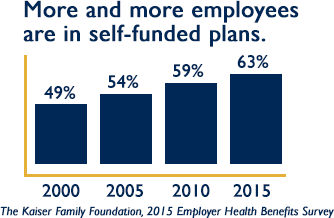
Self-funded medical plans can make great sense for employers large and small who are facing escalating premiums as a result of health care reform. Here are just a few of the benefits of self-funding:

Cost SavingsCost Savings

Tax efficiency

Premiums are taxable in most states at about 2.5%. With self-funding, an employer would only pay tax on its stop loss premium, typically about 10% of health care expenses. By comparison, the employer would pay tax on 100% of its fully insured premium. Plus, self-funded medical plans are exempt from an Affordable Care Act fee that increased premiums on fully insured plans by 2-3%.*

Additional savings

Employers save when claims are lower than expected. Plus, there’s a cap on all claims provided by their aggregate coverage.

Better cash flowBetter cash flow

Employers pay as they go, only for the medical care that employees actually use. As a result, an employer can have greater cash flow on a monthly basis — money that can be invested in other areas.

Plan design flexibility and Greater transparency

The importance of stop loss insurance

Working with an experienced, financially sound insurance company, an employer can take advantage of the benefits of self-funding, while mitigating the financial risk if claims are higher than expected.

Posted in Insurance | Tagged , , , | Leave a comment

Trump most favorable to insurance industry

Republican Donald Trump is the presidential candidate who would be most agreeable for the insurance industry, according to a survey of insurance professionals conducted by A.M. Best.

“On the political front, insurers appear very aware of the ramifications of the 2016 presidential election. Here, the landscape for the insurance industry could look very different, depending on which candidate becomes president,” the Oldwick, N.J.-based ratings agency wrote in its “A.M. Best Winter 2015/2016 Insurance Industry Survey,” which was published late last week.

Most favorable toward insurance industry

For Property & Casualty insurers, Trump, the New York business mogul and reality TV star, is the most popular, with 26.5% of those surveyed saying his policies would be most favorable.

He is followed by former Florida Gov. Jeb Bush (R), who has since dropped out, at 18.5%. Coming in third and fourth, respectively, are Florida Sen. Marco Rubio (11.3%) and businesswoman Carly Fiorina (10.6%). Both have dropped out of the Republican nomination contest.

Trump’s remaining challengers for the Republican nomination — Texas Sen. Ted Cruz and Ohio Gov. John Kasich — come in at fifth and sixth place, respectively, at 9.9% for Cruz and 6% for Kasich.

In seventh place is Democratic front-runner Hillary Clinton, the former secretary of state and senator from New York, who scored 5.3%

She is followed by N.J. Gov. Chris Christie, who has dropped out of the Republican race, at 4%; “Other” (4%); and Dr. Ben Carson and Kentucky Sen. Rand Paul, who have dropped out of the Republican race, at 2% and 1.5%, respectively.

Coming in last is Vermont Sen. Bernie Sanders, who is running second to Clinton for the Democratic nomination, at 0.7%

For Life & Health insurers, Trump again comes out on top, with 26.7%.

He is followed by Bush (22.6%), Rubio (11.7%), Cruz (9.6%), Kasich (7.5%), Fiorina (6.2%), Clinton (4.1%), “Other” (3.4%), Christie (3.4%), Carson (2.7%) and Sanders (2.1%).

Least favorable toward insurance industry

When the question was posed as to which presidential candidate is anticipated as having the least favorable policies for the Property & Casualty industry, the results are lopsidedly reversed.

Sanders comes out on top, with 73.1% and Clinton ranks second, with 15.6%.

She is followed by Cruz and “Other,” tied at 3.3%; Trump and Fiorina, tied at 1.3 %; and Rubio, Christie and Bush, tied at 0.7%.

For the same question concerning the Life & Health industry, Sanders again leads the pack far and away at 77.5% with Clinton trailing at 15.2%.

Ted Cruz comes in next with 3.3%, followed by “Other” at 2.7% and Trump at 1.3 percent. The other candidates scored 0% on the question.

“Overall, there appears to be a favorable perception of the Republican Party’s stated intent to eliminate the Affordable Care Act in its current form. Bernie Sanders’ proposal for Universal Health Care, as well as Hillary Clinton’s proposed policies on prescription drugs, were likely reasons for the negative responses,” A.M. Best wrote in its report.

Posted in Insurance | Tagged , , | Leave a comment

Close Deals Faster By Slowing Down

With everything you have going on every day, slowing down is probably the last thing on your mind. If you’re like me, you try to get things done quickly, and then move on to the next task, and the next; in fact, it never really ends.

Many Realtors® are focused on processing something just enough to “move it down the line”, that is, get the client’s deal to the next stage. They quickly make phone calls, check on listings, and contact partners. Something you may find counterintuitive, though, is that you can often close deals faster when you slow down. Here’s why.

Moving Slower Takes Your Client’s Emotions Into Account

We deal with so many real estate transactions that we often forget how emotional it is to purchase or sell a home. In fact, the emotions of the transaction are something we view as a hindrance to our efficiency. We try to work around them as quickly as possible.

Unfortunately, this kind of speed is counterproductive. When we push on a deal and sidestep the emotions involved, we pressure our clients and can end up with clients backing out of deals, deciding not to sell their homes, or just looking and looking at listings without ever committing to buy.

Instead, close the deal more quickly by slowing down. Talk to your clients about their emotions, let them know they are heard, and don’t push faster than they are willing to go. When you really acknowledge the emotion, you’ll close the deal faster – or, you’ll find out more quickly that they aren’t ready. Either way, you save time and energy.

Moving Slower Helps Catch Details

One transaction fades into the next, and it’s easy to miss small things about a deal. As you probably already know, the small things quickly become big things when you’re scrambling to find an inspector by the inspection due date or suddenly looking for an alternate lender when your buyer failed to qualify.

Moving quickly can mean that we speed past and ignore – or don’t even hear – important red flags when interviewing clients. Juggling too many balls at once means dates fall through the cracks, or you don’t notice a key change in your buyer’s demeanor when discussing their upcoming offer. Missing these details can derail a deal, meaning your time and energy were wasted.

Instead, move slowly enough to keep all the key details in order. Make sure you pay attention to non-verbal cues when interviewing new clients or meeting with existing buyers and sellers. Notice when things aren’t right, and move slowly enough to feel the gut instinct telling you which path to take in a deal. You’ll close more deals and have far less stress in the process.

Moving Slower Avoids Last Minute Derailments

Obviously we can’t avoid every last-minute derailment, but we can prevent some. When we’re moving extremely quickly, we might overlook someone who needs to be involved in the process. Are you so eager to show homes that you convince the husband to see listings before his wife gets back in town? Do you assure the couple who’s selling that their involved mother will love you – even if she hasn’t met you?

When you’re moving too fast, you often try to smooth over cracks and bumps in the process that actually need attention. Unfortunately, those smoothed-over areas can come back to bite you. You’ve probably had it happen – the wife wants to re-see all the listings when she arrives in town, the mother wants the listing to go to another Realtor®, or an “I’m sure it’s fine” crack turns out to be a major issue at inspection.

Instead, move slowly enough to notice and fully investigate the bumps in the road. Wait until the wife is in town – it’ll save you time in the long run. Wait to do your listing presentation until the involved mother can arrive. Make allowances for that small crack to be a big deal. You’ll thank yourself when your deals go more smoothly and derail less often.

Posted in real estate | Tagged , | Leave a comment

The dangers of freezing water & boilers

Figure 1 and an inside view of a stuck, low-water cutoff in a boiler. (Photo: HVACi)

As we enter the heart of winter and turn our attention toward cold weather conditions where freezing water can wreak havoc on commercial and residential property, the threat of catastrophic failure to boilers looms large (as seen in Figure 1).

Although failsafes against significant boiler failures do exist and continue to improve, they remain far from perfect.

One particularly susceptible failsafe is a boiler’s low water cutoff (LWCO). An LWCO is designed to alert the boiler that it does not contain sufficient water to “fire,” and prevents the boiler’s burners from igniting until a safe water level has been restored.

Installation of low water cutoffs

Because these types of failures can lead to injury or death, most state and municipality codes require the installation of low water cutoffs for both residential and commercial boiler applications.

LWCOs are found in one of two designs: Electronic-probe (a more recent technological introduction) and mechanical-float (a traditional, lower-tech version, seen in Figure 2). For this article, we’ll focus our attention on the latter.

(Photo: HVACi)

What is a mechanical-float?

Mechanical-float low water cutoffs are the most widely used water-level safety device in residential and commercial heating boiler applications. These LWCOs are simple in design and function much like fill arms found in residential toilet tanks. As the water level drops in a boiler reservoir, the buoyant arm “floats” down until it reaches a point at which the boiler is unsafe to operate, and the switch turns the heating system off as illustrated in Figure 3.

Common issues with LWCO valves

Despite their simplistic design, mechanical-float LWCOs are prone to several issues, which can have catastrophic impact if not addressed. These issues include:

  1. Stuck valves: Mechanical-float LWCO valves are in constant contact with supply water, and are exposed to minerals, dirt, rust and other total dissolved solids (TDSs). This prolonged exposure to TDSs can interfere with the designed function of the float, preventing it from moving freely up and down in line with the actual water level.
  2. Clogged LWCOs: Sometimes, TDSs and other impurities can prevent the free-flow of water through the LWCO, and can “trick” the LWCO into reporting that an adequate supply of water is present in the boiler, when in fact the minimum safe water level has been breached.


(Photo: HVACi)

Consequences of LWCO failure

If the float is prevented from moving freely and from sending the appropriate signal to the boiler controls (and the burner) to shut down the boiler when the minimum safe water supply level has been breached, the boiler may continue to run without water (or may be allowed to start without water present).

If a boiler operates without the necessary water supply, the heat generated in the boiler’s combustion chamber does not transfer to the water supply, and causes the burner, heat exchanger, and/or boiler tube(s) to overheat. With prolonged or repeated exposure to this condition, the walls of the burner, boiler or heat exchanger may weaken and ultimately crack, as seen in Figure 4.

Freezing conditions, when coupled with LWCO failure, can lead to catastrophic system failure. Should the feedwater pipes for the boiler become frozen (a common occurrence during cold winter months), the system will be starved of water. If the LWCO simultaneously malfunctions, the boiler will start and run without an adequate supply of water.

The cost of LWCO failure

When the heat exchanger or boiler tubes crack or fail, the cost associated with the required labor and parts to repair the boiler (provided the parts are still available since boilers can remain in service for dozens of years) often outweigh the cost of the replacement. The failure of a relatively inexpensive component (usually between $200 and $600, plus installation) can ultimately lead to a residential settlement in excess of $10,000.

Mechanical-float failure prevention

Mechanical-float LWCO valves should be regularly “flushed” to remove TDSs which can prevent the float from moving freely as the water level within the boiler changes. Most manufacturers recommend flushing the boiler at least once per season (some field technical experts say as often as weekly) by opening the “blow down valve,” which sits beneath the LWCO line and allows harmful deposits to escape. Boiler feedwater should be chemically treated to prevent scaling and to maintain proper pH levels for optimal boiler efficiency and performance.

The prevalence of boilers in residential and commercial heating applications makes the threat of LWCO failure real.

Posted in homes, robertjrussell | Tagged , , , | Leave a comment

White House Website Updated for New Administration

Posted in Business | Tagged , , | Leave a comment

Trump signs ACA burden relief executive order

Trump says agencies that get the order should comply with the federal Administrative Procedure Act and other federal regulatory revision laws. (Photo: Trump's office)

President Trump started his presidency by signing an executive order that seeks to minimize any burdens caused by the Patient Protection and Affordable Care Act.

In the order, Trump states that the administration is working to have PPACA repealed.

“In the meantime, pending such repeal, it is imperative for the executive branch to ensure that the law is being efficiently implemented, take all actions consistent with the law to minimize the unwarranted economic and regulatory burden of the act, and prepare to afford the states more flexibility and control to create a more free and open healthcare market,” according to the text of the order.

Trump authorizes the secretary of the U.S. Department of Health and Human Services and other executive departments and agencies to minimize PPACA-related burdens to the maximum extent permitted by law, by waiving, deferring granting exemptions from or delaying the implementation of provisions that would pose a fiscal or regulatory burden on “individuals, families, healthcare providers, health insurers, patients, recipients of healthcare services, purchasers of health insurance, or makers of medical devices, products or medications,” according to the order text.

Trump does not mention the second law in the two-law Affordable Care Act package, the Health Care and Education Reconciliation Act, in the order.

Trump does say that agencies should continue to comply with the federal “Administrative Procedure Act and other applicable statutes in considering or promulgating such regulatory revisions,” according to the text.

Implementation of the order will be subject to the availability of appropriated funding, and that the order does not create a right for anyone to sue the United States, its departments, its agencies or its officials, according to the text.

Posted in Insurance | Tagged , , | Leave a comment

5 Good Reasons to Have a Broker’s License

Goal settingWhy Get Your Brokers License?

In many states there are lower license statuses than having a full broker’s license. For instance in Tennessee, you must have an affiliate brokers license for at least 3 years, take and the Broker’s Office Management Course and have dozens of additional educational hours to qualify to take the broker’s exam. With all that extra work, why should an agent aspire to get a Brokers License?

  1. It is good to set goals. If you plan to stay in the real estate business this is a natural step to attain and certainly will not hurt you.
  2. The education is good for you. Taking those extra classes will let you know what is involved in being a broker or owning or running a real estate brokerage. You will see it from the other side.
  3. Some respect comes from this level of licensure. Your peers and even the public realize that it is an achievement and may seek you out.
  4. It opens doors of opportunity. In Texas, you can open you own company, become a manager or trainer, teach real estate classes and in some situations even hold more positions and roles at your local Realtor® Association.
  5. It’s liberating. Having a brokers license means you are in control of your future and have choices. I tell new agents to work toward getting their brokers licenses because it just makes sense for their career growth. The benchmark or state requirements can change in the future and getting one in the future may be a lot harder.

I think it’s a smart thing to do. Having more knowledge is powerful and having more options enables you to look at your future with bigger eyes.

Why Get Your Broker’s License? It is liberating. I have never regretted having a brokers license which enabled me to manage agents and open my own real estate company. Many opportunities would have passed me by if I had not had it. You may never choose to manage agents or own a company but I can guarantee that knowing you could if you wanted to is empowering.

If you thinking about getting your Broker’s License, is it on your plan for this year?

Posted in real estate, robertjrussell | Leave a comment

Trump backs ‘simultaneous’ ACA repeal and replacement

“It’ll be repeal and replace. It’ll be essentially simultaneously,” President-elect Donald Trump said Wednesday in his first press conference since the election.

President-elect Donald Trump said the Affordable Care Act, which he calls “Obamacare,” should be repealed and replaced “essentially simultaneously,” weighing in on a political debate among Republican lawmakers who are grappling with how to tackle the effort.

“It’ll be repeal and replace. It’ll be essentially simultaneously,” Trump said Wednesday in his first press conference since the election.

Trump didn’t provide details of his plans for the Affordable Care Act, but indicated that his administration will present replacement proposals after his pick for Health and Human Services secretary is confirmed, a process that could take weeks. Senators are set to vote this week on an initial step to repeal Obamacare via a budget process, with a target date later this month for more detailed repeal plans. But some Republicans have become wary of doing away with the ACA before a replacement plan is ready, and called for a delay in the process.

“We’re going to be submitting, as soon as our secretary’s approved, almost simultaneously, shortly thereafter, a plan,” Trump said at Trump Tower in New York. “We’re going to do repeal and replace, very complicated stuff, and we’re going to get a health bill passed.”

Timeline questions

Georgia Republican Congressman Tom Price, the president-elect’s pick for HHS secretary, faces a hearing next week in front of the Senate’s health committee, although the key hearing for his confirmation hasn’t yet been scheduled.

Trump’s remarks appear to push back the timeline for action on Obamacare from comments he made Tuesday to the New York Times. He told the newspaper that a repeal vote should be held “probably some time next week” and that a replacement should come “very quickly or simultaneously, very shortly thereafter.”

A group of five GOP senators has been working to extend the date for an initial step in the repeal process to early March from this month, to allow more time to design a replacement plan. In the House, members of the conservative Freedom Caucus want to see details about how Obamacare would be replaced before voting to begin repeal efforts.

Lamar Alexander, the Tennessee Republican who heads the Senate’s health committee, said Tuesday that Obamacare should be repealed “only when there are concrete, practical reforms in place that give Americans access to truly affordable health care.” He’s proposed plans to first shore up the Affordable Care Act’s existing markets, before crafting a replacement and repealing the health law.

Posted in Insurance, robertjrussell | Leave a comment

Repeal of Obamacare

Mike Pence told Republicans that Trump, on his first day in office, plans to take action on Obamacare through executive orders aimed at making sure the insurance marketplace isn’t disrupted by a repeal. (Photo: iStock)

At the end of a day when incoming and outgoing presidents tussled over the fate of U.S. health care, it was the words of Vice President-elect Mike Pence that seemed to matter most to anxious investors.

Pence, in a visit to Congress, sought to ease concerns that a repeal of Obamacare would be done so abruptly that it leaves millions of Americans without insurance and throws health-care companies into chaos across the country. He told reporters that he was talking with Republican leaders to coordinate “both a legislative and executive action agenda to ensure that an orderly and smooth transition to market-based health care system is achieved.”

Earlier in the day, the mood was more strained. President-elect Donald Trump, calling Obamacare “a disaster” on Twitter Wednesday, urged Republicans not to take the blame for the law as they start a process to change it. Meanwhile, President Barack Obama urged Democrats on Capitol Hill to resist efforts to repeal his signature domestic policy achievement.

“It will be important that we are careful in how we do that,” Pence said at a news conference with House Speaker Paul Ryan.

Another provision could affect efforts to help the Social Security Disability Insurance program.

Enormous challenges remain, including debate within the GOP over how quickly to proceed with their plans. Yet the remarks sent hospital stocks rising on Wednesday, as Community Health Systems Inc., HCA Holdings Inc. and Tenet Healthcare Corp. all had their best day of trading since November.

Obama meeting

At the same time, Obama — in his final weeks in office — met with Democrats on Capitol Hill to discuss how to defend the Affordable Care Act from being upended by the unified Republican presidency and Congress. The Republican plan would “make America sick again,” Minority Leader Chuck Schumer said at a news conference afterward. The administration announced on Wednesday that 8.8 million people have so far signed up for coverage this year under the law, more than at the same time last year.

Representative Louise Slaughter, a New York Democrat, scoffed at the GOP’s repeal strategy, saying, “You wouldn’t think of tearing down a house before you have a new one.” Asked whether she intends to work with Republicans on a replacement, she said no.

New York’s Schumer told reporters that Democrats’ position is that Republicans must first put forth a replacement plan. Then Democrats will respond and decide their next step.

“I think we have unanimity in our caucuses on that position,” he said.

Pence told Republicans during their private meeting that Trump, on his first day in office, plans to take action on Obamacare through executive orders aimed at making sure the insurance marketplace isn’t disrupted by a repeal, according to Representative Chris Collins of New York, one of Trump’s earliest House GOP backers.

Republicans hope to have a replacement plan on paper in six months, Collins said.

GOP split

There are GOP divisions on what steps to take first. Some want to see a full health care program before voting to repeal the law, and others want to repeal it first and work on replacement after.

Maine Republican Senator Susan Collins, a moderate, told reporters she would like to see a “detailed framework for what replacement is going to include as we are moving toward repeal.” She said she would look at a replacement policy before giving her vote to repeal efforts.

“I want to make sure that we don’t have a gap that leaves people who have coverage without coverage” after repeal, Collins said.

A leading House conservative, Representative Jim Jordan of Ohio, said he wants repeal done quickly. “I don’t want that to turn into some 2, 3, 4-year phase-in,” he said.

Posted in Insurance | Tagged , | Leave a comment