Automate your Real Estate searches…

adwerx_5_digital_marketing_hacks_craft

Real estate professionals must embrace savvy digital marketing strategies in our hyper-connected world. Within these strategies are specific tactics that can transform your marketing from the mundane to the magnificent. There’s value in postcards, calendars, and business cards, but digital marketing is the best way for real estate professionals to leverage their money and time. Allow me to present the top five digital marketing hacks for real estate professionals.

Blogging and SEO

Many have extolled the virtues of blogging and its SEO benefits. It’s for good reason, though. Consistent blogging on a hyper-local, neighborhood level establishes you as a trusted voice in your community. Consistent blogging also helps your name/brand show up higher in organic search results. Blog content is the foundation for search engine optimization (SEO). Blog content is also the fuel for your social media activity.

Automate with IFTTT

IFTTT stands for “If This Then That.” On the basic level, you can use IFTTT to share your evergreen blog content to your various social media channels every day or even every hour. But beyond social media sharing, this internet tool can help you market and control utilities for a listing with your hands off. Smart-connected home tools and tasks (lights, Nest A/C settings, and more) are all manageable on IFTTT. Cool stuff like makes for neat “talking points” and digital marketing hacks for real estate. Have fun with social media marketing automation and more at ifttt.com.

Posted in Business | Tagged , , , , | Leave a comment

Insurance and Same Sex Marriages

Here are some important FAQs about HSAs relating to same-sex marriages. Photo: Getty

Navigating Health Savings Accounts (HSAs) and high-deductible health plans (HDHPs) is complicated enough, but after the Supreme Court ruling on June 26, 2015 recognized same-sex marriages, employers and employees found the rules remained complex.

The SCOTUS ruling, Obergefell v. Hodges, was a landmark decision for same-sex couples and their families, and also for the HR and financial professionals who work with them to provide information and resources on HDHPs and HSAs.

To help you learn more about HSAs and how the 2015 ruling affects them, here are some important FAQs to start your research:

#1: How did the Supreme Court’s 2015 ruling that all states must allow same-sex marriages impact HSAs?

The Supreme Court’s 2015 ruling in Obergefell v. Hodges allowing for same-sex marriages in all 50 states will impact HSAs for same-sex couples that legally marry in a state that previously forbid marriage for same-sex couples. Prior to the ruling, only same-sex couples that were legally married and recognized by the state law as “spouse” could take advantage of the special rules available to “spouses” under HSA law. Domestic partners or same-sex civil unions were not granted the same status as “spouses” under HSA law. Now all states must allow for same-sex marriages and treatment as spouses under HSA law for married same-sex couples.

Same-sex couples will have to be legally married to gain the benefit of “spouse” status under HSA law. From a health benefits perspective, legal marriage may become financially important to same-sex domestic partners if employers stop offering health insurance benefits to domestic partners. Some employers will likely drop benefits for domestic partners now that same-sex marriage is allowed.


#2: Is a domestic partnership or civil union the same as marriage?

No. The IRS states that for federal tax purposes the term “spouse” does not include “registered domestic partnerships, civil unions, or other similar formal relationships recognized under state law that are not denominated as a marriage under that state’s law…” This is true for same-sex and opposite-sex relationships. “Spouse” is the key word for HSA laws but “marriage” is generally the state classification that results in couples becoming “spouses.”

#3: Can an HSA owner use an HSA to pay the medical expenses for a same-sex spouse?

Yes.

#4: Can HSA owners use HSA funds to pay medical expenses of domestic partners?

No. HSA owners can only use their HSAs to pay for the medical expenses of their spouses or their dependents. If a domestic partner meets the IRS requirements as a dependent (IRS Code Sec. 152), then the HSA owner can use his or her HSA for a domestic partner’s medical expenses. Meeting the definition of a “dependent” is difficult for nonchildren. If the HSA owner’s state recognizes same-sex marriages with the result being that the domestic partners are considered “spouses” (married), rather than domestic partners (or are spouses in addition to being domestic partners), then the HSA owner can use an HSA to pay for qualified medical expenses of a spouse.

Photo: Getty

#5: Can an HSA owner contribute the family HSA limit if the only other person on the family HDHP is a domestic partner or same-sex spouse?

Yes, in order to contribute the family HSA limit ($6,750 for 2016), an HSA owner must be covered by a family HDHP (covers the HSA owner and at least one other person). If that other person is a domestic partner, then the HSA owner has a family HDHP and can contribute the family limit if otherwise eligible for an HSA.

The rule is pretty straightforward in this area and to get the family contribution limit you simply need to be covered under a family HDHP, meaning the HSA owner and at least one other person be on the plan. That other person could be a spouse (same-sex or not), domestic partner (same-sex or not), child, or potentially someone else allowed on a family HDHP. The difference between same-sex domestic partners and same-sex married couples is significant for contributions. See the following question for more information and for distributions.

Photo: Getty

#6: Does the rule requiring married couples to coordinate their maximum family HSA contribution apply to domestic partners and same-sex spouses?

One potential downside for same-sex couples is that the Supreme Court’s ruling striking down the Defense of Marriage Act and the subsequent ruling in 2015 allowing for same-sex marriages in all the states is that it partially closed a loophole that allowed for domestic partners to make larger HSA contributions. HSA law caps spouses’ combined HSA contributions to the family limit ($6,750 for 2016) if one or both spouses had family HDHP coverage. Same-sex couples avoided that cap when they were not considered spouses and could each potentially contribute the maximum limit if they were covered under a family HDHP (i.e., they could each contribute $6,750 for 2016).

Spouses are subject to a couple of special rules in this regard: 1) if either spouse has family HDHP coverage, both spouses are deemed to have family HDHP coverage, and 2) combined the spouses cannot exceed the family HDHP limit.

Whether the loophole is still available to same-sex couples depends on whether or not the couple is legally married under state law.

Posted in Business | Tagged , , | Leave a comment

Best Cities to Flip Houses

With more than 110,000 house-flipping investors in 2015 — the highest rate since 2007 — and an average gross profit of $55,000, the personal-finance website WalletHub took an in-depth look at 2016’s Best Cities to Flip Houses.

To help serious real-estate investors find the best markets to list their flipped properties, WalletHub’s number crunchers compared the 150 largest cities based on 19 key metrics. Our metrics range from “median purchase price” to “average full home remodeling costs” to “housing-market health index.”

Top 20 Cities for Flipping Houses
1 Sioux Falls, SD 11 Tulsa, OK
2 Fort Wayne, IN 12 Corpus Christi, TX
3 El Paso, TX 13 Nashville, TN
4 Oklahoma City, OK 14 Peoria, AZ
5 Lincoln, NE 15 Cape Coral, FL
6 Lubbock, TX 16 Gilbert, AZ
7 Tampa, FL 17 Des Moines, IA
8 New Orleans, LA 18 Pembroke Pines, FL
9 Boise, ID 19 Springfield, MO
10 Laredo, TX 20 Grand Rapids, MI

Best vs. Worst

  • Pittsburgh has the highest average gross return on investment, 129.5 percent, which is 6.1 times higher than in Austin, Texas, the city with the lowest, 21.2 percent.
  • Cleveland, has the lowest median purchase price, $45,000, which is 12.9 times lower than in San Jose, Calif., the city with the highest, $580,000.
  • Memphis, Tenn., has the highest percentage of home flips, 11.1 percent, which is 3.5 times higher than in Austin, Texas, Indianapolis and Pittsburgh, the cities with the lowest, 3.2 percent.
  • Plano, Texas, has the highest housing-market health index, 9.81, which is 88.3 times higher than in Jackson, Miss., the city with the lowest, 0.11.
  • Orlando, Fla., has the highest number of real-estate agents per 100,000 residents, 171.54, which is 20.5 times higher than in Oxnard, Calif., the city with the lowest, 8.38.
  • Mobile, Ala., has the lowest average kitchen remodeling costs, $13,336, which is 4.2 times lower than in Newark, N.J., the city with the highest, $56,108.
  • Fort Wayne, Ind., has the lowest average bathroom remodeling costs, $5,238, which is 4.7 times lower than in San Francisco, the city with the highest, $24,506.
  • Little Rock, Ark., the city with the lowest average full home remodeling costs, $75,888, which is 5.0 times lower than in Boston, the city with the highest, $377,598.
  • Yonkers, N.Y., the city with the lowest property-crime rate per 1,000 residents, 10.01, which is 8.5 times lower than in Spokane, Wash., the city with the highest, 85.59.

For the full report and to see where your city ranks, please visit:
https://wallethub.com/edu/best-cities-to-flip-houses/23158/

Please let me know if you have any questions or if you would like to schedule a phone, Skype or in-studio interview with one of our experts. Full data sets for specific cities are also available upon request.

Posted in real estate | Tagged , , | Leave a comment

How much do you need to make to afford renting?

The Rent For A Two-Bedroom Is Too High Just About Everywhere

In 2015, the demand for rental apartments reached its highest level ever since the 1960s. The pinched access to mortgage credit after the Great Recession is one reason why. Another is that many Americans—especially the poor and people of color—haven’t felt the effects of the economic recovery, and may not be able to rustle up the funds for a down payment. A third reason is that Millennials, now the largest generation ever since the baby boomers, are especially loath to buy homes. The supply of rentals, especially at the lower end of the market, has been no match for the skyrocketing demand.

That means it’s getting harder and harder for average Americans to afford a modest rental in the U.S., a new report by the National Low Income Housing Coalition finds. “The lowest-income renters without housing assistance have always struggled to afford housing, but in recent years they have become even more squeezed as more households enter the rental market,” Andrew Aurand, the vice president of research at NLIHC, tells CityLab.

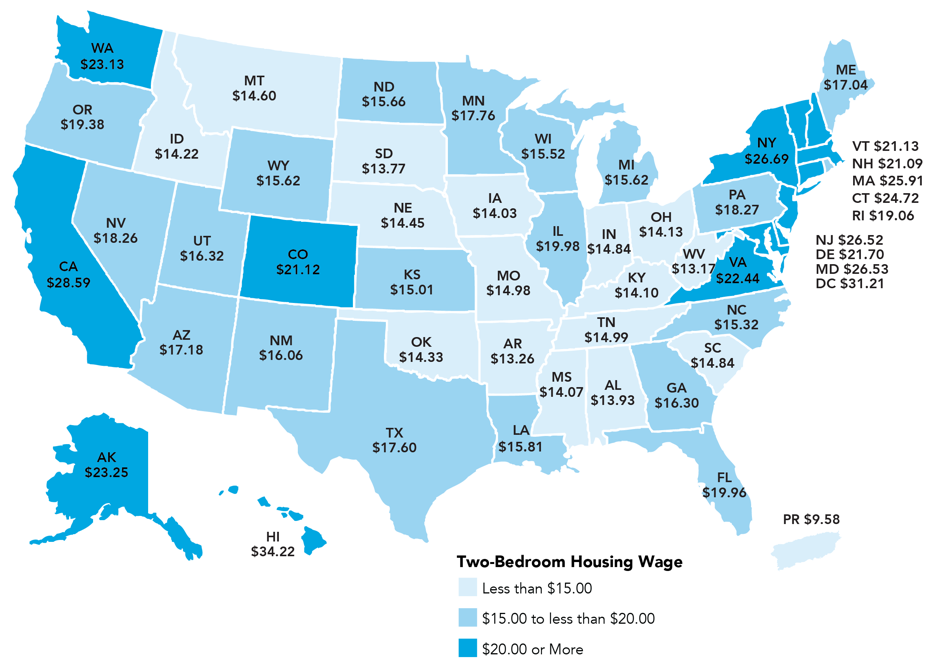
In 2016, a worker would need to make $20.30 per hour to rent a two-bedroom accommodation comfortably—without devoting more than 30 percent of income on housing costs. Last year, NLIHC pegged this “housing wage” at $19.35 an hour. (And we’re not talking about luxury apartments here. The report tallies this average hourly wage against the Department of Housing and Urban Development’s Fair Market Rent, an annual estimate of what a family might pay to live in a simple apartment.)

To really understand the weight of 2016’s housing wage, consider this: The average hourly wage for Americans is actually $15.42 per the report, which is not nearly enough to afford a two-bedroom. And the federal minimum wage, at $7.25, is around a third of what’s required. That means minimum-wage workers would have to work three jobs, or 112 hours a week, to be able to afford a decent two-bedroom accommodation. From the report:

If this worker slept for eight hours per night, he or she would have no remaining time during the week for anything other than working and sleeping.

Of course, both the rental-housing market and hourly wages vary by state. The map below illustrates the differences in “housing wages” by state. Among the states, Hawaii has the highest hourly wage requirement ($34.22) for a two-bedroom. Among U.S. metros, San Francisco is at the top with $44.02.

Want to know more? Visit: http://www.robertjrussell.com

Save

Posted in real estate | Tagged , , , | Leave a comment

Unum Completes Purchase of Starmount Life, AlwaysCare

Starmount Life Insurance Company and sister company AlwaysCare Benefits have announced that both are now part of Unum, a leading nationwide provider of financial protection benefits at work, including disability, life and supplemental health products.
An ideal fit for Unum, Starmount will serve as the national Center of Excellence for dental and vision operations supporting both Unum US and Colonial Life, and help to expand access to dental and vision benefits at the workplace and to individuals across the country.
Now the fourth brand under the Unum Group umbrella alongside Unum US, Unum UK and Colonial Life, Starmount will remain headquartered in Baton Rouge, Louisiana, with a leadership team including CEO Erich Sternberg and President Deborah Sternberg, and the entire staff of more than 220 employees.
Posted in Insurance | Tagged , , | Leave a comment

Strong gains for Texas homes activity – prices

Mortgage rates have edged lower so far this week according to Bankrate.com.

It says that the average 30-year FRMs were down Monday to 3.36 per cent, 7 basis points lower than a week ago; 15-year FRMs averaged 2.65 per cent, down 4 basis points; 5-year ARMs averaged 2.87 per cent, down 6 basis points.

The largest drop was for 30-year jumbo FRM loans which fell 18 basis points in the week to 3.82 per cent.

Strong gains for Texas homes activity, prices
Sales and prices of homes in Texas saw strong gains in the second quarter of 2016. The Texas Association of Realtors reports that 91,418 homes were sold in the three-month period, up 4.4 per cent from the same time a year ago.

“The last few months have been one of the strongest starts to the summer selling season in the history of Texas real estate,” said Leslie Rouda Smith, chairman of the Texas Association of REALTORS®. “Texas homes of all types and price classes are in high demand. This is especially true for homes priced under $200,000, which are often preferred by first-time homebuyers but also in shortest supply across the state.”

Prices appreciated 7.5 per cent year-over-year to reach a median $215,000 in the second quarter of 2016.

Texas remains a seller’s market with housing inventory at 3.7 months, unchanged from the first quarter of 2016; active listings increased 4.1 per cent year-over-year.

Builders highlight benefits of system-built homes
System-built homes, which are prefabricated in a controlled setting and include modular, panelized, concrete, log and timber framed homes, provide homeowners with a building alternative that often saves time and money.

This week members of the National Association of Home Builders are highlighting the benefits of system-built homes over the traditional stick-building method.

Save

Posted in real estate | Tagged , , | Leave a comment

Questions and Answers about Health Benefits

By understanding the top-of-mind employer benefit issues and responding to them appropriately and effectively, brokers and advisors can better serve existing clients, attract new ones, and help employees protect themselves and their families going forward. Photo: Getty Images

Legislative changes continue to markedly affect the health benefits marketplace. Employers and their workers face challenges on a number of fronts. Along with those challenges come questions that range from current and future requirements of health care reform, to providing adequate plan coverage that serves employees well.

By understanding the top-of-mind employer benefit issues and responding to them appropriately and effectively, brokers and advisors can better serve existing clients, attract new ones, and help employees protect themselves and their families going forward.

Advertisement

1.     How can I meet my employees’ needs?

A key concern of today’s employers is making sure benefits they offer for both prospective and current employees are competitive. Businesses recognize the role a solid benefit program plays in attracting and keeping good talent, and they want to know what is included in plans offered by their competitors.

Brokers serving the health benefits marketplace can best serve customers by knowing the current market landscape well, speaking confidently about it and sharing that knowledge with customers. Key to this knowledge is understanding what the employer currently offers, what types of employees make up its workforce, what their needs are, and what gaps may currently exist.

Then, talk with insurers and learn what industry and market insight they may possess based on geographic and industry-specific factors. Search out findings made available from insurance- and customer-specific industry research organizations and trade associations. You can also mine data from within your own office, such as aggregated customer information by industry.

Integrate all of this information with comprehensive benefit offerings available from the carriers you represent, and show employers how they can gain a competitive market advantage with the right benefit plan.

2.     How can I control my costs?

The question of controlling costs is common for obvious reasons. Small groups, in particular, are looking for creative ways to keep their health benefit expenses down. Brokers can address this question by understanding current offerings and combining that with knowledge of the plans available through the carriers they represent.

Understanding the various coverage tiers available and sharing that knowledge with employers is key. Often, implementing a health benefit program that meets the minimum required coverage levels brings the lowest cost.

Other cost-reduction strategies include addressing coverage for dependents or part-time employees. Some employers may consider eliminating dependent coverage or reducing contributions for this coverage. Also, determine with the employer the cost versus the benefit of including part-time staff in the plan. Employers may need to make tough decisions to maintain viable programs for employees.

Employers need to consider other costs that may come into play. For example, new IRS and ACA reporting requirements for employers to notify employees about new mandates bring with them administrative expenses. While they may not be able to eliminate these costs, brokers can help provide guidance and increase awareness around the changing requirements. They can also recommend approaches that might help employers streamline the process to reduce the impact of the requirements.

3.     What about exchanges?

Employer questions about health benefit exchanges are prevalent. How do the exchanges align with the employer’s desire to deliver benefits in a cost-effective manner? What advantages do they offer? What are the drawbacks? Brokers need to be familiar with individual and group exchanges — both private and public.

Brokers working with some employers may find that certain tax advantages come along with using a public exchange. Private exchanges offer other benefits, from cost-management tools to a broader set of administrative support options and a choice of benefit options that extend beyond basic medical coverage. Group or employer-focused exchanges are becoming increasingly popular as a way to efficiently manage health benefits. Brokers should become familiar with the pros and cons, as well as processes involved.

It’s important to understand the advantages for different employer groups, as well as the reputation and satisfaction levels of exchanges, and use that knowledge to help employers select the right option.

4.     What’s on the horizon?

Large employers are concerned about looming changes. They wonder how new regulations—for example, the Cadillac tax —may affect them in the future. Brokers need to be knowledgeable about what is coming down the pike, and how to minimize negative resulting impacts.

Preparing for the Cadillac tax, for example, may require a strategy shift. While the tax is primarily levied against health plans for coverage deemed “too rich,” it will ultimately affect employers and workers. Health plans are likely to pass off at least some of the costs to employers in the form of higher premiums. Employers may then pass costs off to workers in the form of higher cost-sharing arrangements. Of course, employers will have to consider how this will impact employee retention and recruitment.

The Internal Revenue Service posts helpful information about the ACA’s requirements on employers on its website: irs.gov/affordable-care-act. The Centers for Medicare & Medicaid Services website is another valuable resource: cms.gov/cciio/.

5.     Why you?

The final top question may be one employers don’t explicitly ask; but it’s one you need to answer: “Why should I use you as a broker?” How is it that you set yourself apart from other brokers — industry knowledge, market strategy or customer service? Brokers need to carefully and clearly explain benefit plan designs, educate employers, guide them through the maze of changes in the benefits arena, and explain all the implications.

Building knowledge is the first part of the answer. Learn about laws, regulations and your employers’ workforce attributes. Learn more about the products offered by carriers and through the exchanges. Combine that knowledge with employer and employee data you capture to design programs that can help employers attract and retain good workers. Work with financially strong carrier partners to find and deliver the right benefit plans, and consider offering your clients a multi-year strategy where appropriate. And leverage administrative, technology, client portals and other resources your carrier partners offer.

Be sure to document and explain the advantages you can bring to the employer. Also, encourage satisfied customers to provide testimonials, directly and on social platforms, and then share these testimonials and references to help differentiate yourself and your shop from your competitors.

By understanding the needs of your clients, offering cost control solutions and keeping businesses apprised of changes on the horizon, you set yourself apart from other brokers and demonstrate your value as a trusted adviser. New and existing clients will come to you year after year for help in designing affordable health benefit plans that will attract and hold onto good workers.

Posted in Insurance | Tagged , , | Leave a comment

Company Branding and Structure

In a market place where diversity is commonplace, catering to niches is not only necessary, it is a smart, and profitable strategy.

As the U.S. continues to diversify, the real estate industry becomes increasingly fragmented and specialized. However, just like the country where you can have a Native American, Asian American, African-American, Hispanic American, or any other combination of ethnicity followed by “American,” any well-run firm would benefit to have a diverse staff to operate well in a diverse community. Diversification is a natural progression and not an option, particularly where diversity prevails.

Here in San Francisco, California where Anglos (or Euro-Americans?) represent a slight minority, and the rest of the population represent the proverbial melting pot of ethnicities (the diversity that makes this area an exciting microcosm of cultures, languages, traditions and international flavors), companies embracing diversification tend to thrive, while those that don’t, with the exception of bigger companies with a history, are either adapting or will disappear under the weight of the economic changes that continue to affect our industry.

For instance, those firms that have adapted typically have teams of one ethnic group or another, e.g., one office in the geographic area popular among Asians have a contingent of agents that not only speak the language but share the culture and are effective at serving that community, thus creating alternative income flows to the firm as a result. They accomplish this by specifically targeting both the public as well as the agents they need to attend to that public. Some companies embracing this mindset in the heyday of the first-time buyer, no money down frenzy established groups deliberately catering to buyers that were targeted by the language or the ethnicity, rightly or not. The idea of diversification isn’t to single out a community for questionable purposes, but rather to cater to the existing needs of the same.

I witnessed how the company’s culture would spill over to the clients they attracted and served, albeit in a haphazardous fashion as opposed to a planned strategy. However, a company must establish a clear objective in undertaking any strategy to reach a specific niche, and what it is prepared to do to make inroads therein.

For starters, a company with such a marketing plan would do well to determine the size, customs, nature and shopping trends of the target group; not unlike the demographic studies done by any major franchise organization prior to undertaking a new location. Alas many real estate companies leave most of these sorts of investigative steps to random samplings, if done at all. A good broker/manager or company leader reviews where business is coming from and goes about creating paradigm shifts either in the recruitment or in the outreach, e.g., marketing, promotions, etc., for such endeavors.

One company where I witnessed this type of insight was a firm that catered to the Latino community in their midst by hiring predominantly Latino agent, in spite of the owner of the company being of Asian descent! Another firm that was located in a predominantly Asian community focused its marketing campaigns in that community by placing strategic billboards in the language of choice and attracting that populace to the firm. Another firm run by a middle-eastern gentleman attracted his client base through television advertising catering to “his” community through targeted ads in the language of choice.

This is a smart approach, albeit, as I pointed out earlier, hap hazardous. A firm looking to stay viable in a changing economy needs to create an environment where such creative outreach isn’t left to whim or accident or worse, to the imagination of a well-meaning agent or group of agents in the office. I recall a major franchise attempting to do something along these lines early on. They went about it in a way that seemed to be right – they even bought a magazine in the target market’s language! However, without a guiding principle, or someone who understood the niche well enough, this quickly went down a predictable path. The company shut down the magazine and all but abandoned their drive to attract the community they targeted.

This diversification isn’t solely about producing marketing pieces in the native language – something that can backfire due to poorly translated concepts if not wording. Rather it is about developing a complete strategy and creating the right venue to accomplishing this – from marketing materials to appropriate dissemination points, e.g., radio, print, flyers, to telecommunications and websites and having the right, trained personnel, including a leader, to complement that effort.

If done properly a company will reap a greater benefit from this type of diversification and keep greater control of a changing market and the niche it is creating or attracting. And it isn’t about leaving any one agent or group of agents to their own devices because this leads to losing control of the very vehicle that is being developed.

Presently there are numerous companies following this trend. However, many of them are doing so through the efforts of an agent or two, who, with some insights have stumbled upon virgin, and potentially lucrative territory. Let’s face it, many non-traditional markets lack of information and leadership that is prevalent elsewhere, so it isn’t too difficult to see that one well-heeled agent can capture a greater share of a given market. A company could do much more if they created the right approach with the right resources – and it isn’t about investing a great sum of money, after all, look around and see how many banks; title companies, home warranty companies, and other service providers now provide gratis many marketing materials in different languages. What it does require is someone to take the lead to create the right blend of resources, facilities and opportunities to attract the (untapped or underserved) group(s) you see, through your investigations, as a viable source of your future business. Oh, and remember to bring on the right people to help you serve them properly – in their language where ever possible.

There are numerous examples of how effective this strategy is throughout the country. Some companies have grown to become larger firms just following a simple approach – find a need and fill it, oh, and you don’t have to speak the language, but having the right key people who do is the way to go.

Posted in Business | Tagged , , | Leave a comment

Fastest Growing Group on Facebook

Cover Photo

This group is for Employers who are looking for key employees for their company. It is also for individuals who are looking to change careers whether it is full time or part time.

Here is the URL if you want to join: https://www.facebook.com/groups/EmploymentSearch/

Once you have proven that your posts can be trusted then the administrator will put you on Auto-Post. You MUST prove yourself first – no exceptions

If you are a Business Owner feel free to post your candidate search here. If you are a hiring candidate, you can post what type of job you are looking for.

To the business owner and hiring candidate – we offer Group Insurance and Health Insurance for people in between jobs – visit: http://www.InsurancePricedRight.com/

Posted in Social Media | Tagged , , | Leave a comment

Finances – Keeping Currency Current

In case you missed it, US currency is undergoing a makeover. On April 20th, 2016, Treasury Secretary, Jacob Lew, announced plans to redesign the $5, $10 and $20 note. The redesign started off with the idea to change the face on the $10 note; however, after months of consideration, the $5 and $20 note was also added to the redesign plans.

According to an open letter published by Lew, below are the redesign plans:

$5 Note

  • Face: Will continue to feature President Lincoln.
  • Reverse: Will depict the historic events that have occurred at the Lincoln Memorial: In 1939, at a time when Washington’s concert halls were still segregated, world-renowned opera singer Marian Anderson helped advance civil rights when, with the support of First Lady Eleanor Roosevelt, she performed at the Lincoln Memorial in front of 75,000 people. And in 1963, Martin Luther King, Jr. delivered his historic “I Have a Dream” speech at the same monument in front of hundreds of thousands of people.

$10 Note

  • Face: Will continue to feature Alexander Hamilton, our nation’s first Treasury Secretary and the architect of our economic system.
  • Reverse: Will honor the story and the heroes of the women’s suffrage movement against the backdrop of the Treasury building. Treasury’s relationship with the suffrage movement dates back to March of 1913, when advocates came together on the steps of the Treasury building to demonstrate for a woman’s right to vote, seven years prior to the passage of the 19th Amendment. The new $10 design will depict that historic march and honor Lucretia Mott, Sojourner Truth, Susan B. Anthony, Elizabeth Cady Stanton, and Alice Paul for their contributions to the suffrage movement.

$20 Note

  • Face: Will feature a woman, Harriet Tubman – leader of the underground railroad and an advocate for women’s right to vote.
  • Reverse: Will continue to feature the White House as well as an image of President Andrew Jackson.

According to the open letter, “final concept designs for the new $20, $10, and $5 notes will all be unveiled in 2020 in conjunction with the 100th anniversary of the 19th Amendment, which granted women the right to vote.”


Posted in Business | Tagged , , | Leave a comment