Renters Struggle to Pay Rent

In 2015, the demand for rental apartments reached its highest level ever since the 1960s. The pinched access to mortgage credit after the Great Recession is one reason why. Another is that many Americans—especially the poor and people of color—haven’t felt the effects of the economic recovery, and may not be able to rustle up the funds for a down payment. A third reason is that Millennials, now the largest generation ever since the baby boomers, are especially loath to buy homes. The supply of rentals, especially at the lower end of the market, has been no match for the skyrocketing demand.

That means it’s getting harder and harder for average Americans to afford a modest rental in the U.S., a new report by the National Low Income Housing Coalition finds. “The lowest-income renters without housing assistance have always struggled to afford housing, but in recent years they have become even more squeezed as more households enter the rental market,” Andrew Aurand, the vice president of research at NLIHC, tells CityLab.

In 2016, a worker would need to make $20.30 per hour to rent a two-bedroom accommodation comfortably—without devoting more than 30 percent of income on housing costs. Last year, NLIHC pegged this “housing wage” at $19.35 an hour. (And we’re not talking about luxury apartments here. The report tallies this average hourly wage against the Department of Housing and Urban Development’s Fair Market Rent, an annual estimate of what a family might pay to live in a simple apartment.)

To really understand the weight of 2016’s housing wage, consider this: The average hourly wage for Americans is actually $15.42 per the report, which is not nearly enough to afford a two-bedroom. And the federal minimum wage, at $7.25, is around a third of what’s required. That means minimum-wage workers would have to work three jobs, or 112 hours a week, to be able to afford a decent two-bedroom accommodation. From the report:

If this worker slept for eight hours per night, he or she would have no remaining time during the week for anything other than working and sleeping.

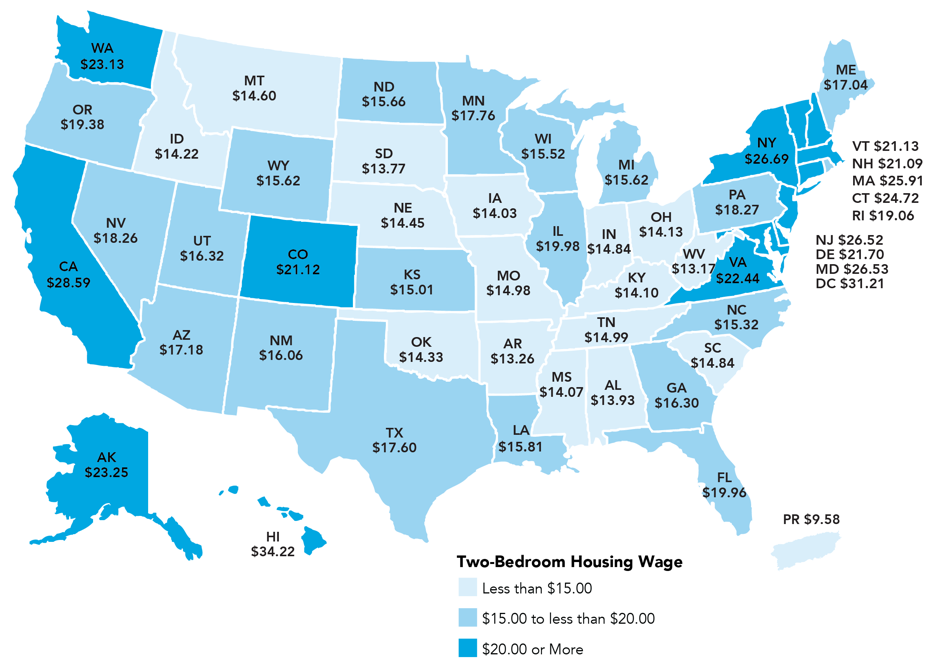
Of course, both the rental-housing market and hourly wages vary by state. The map below illustrates the differences in “housing wages” by state. Among the states, Hawaii has the highest hourly wage requirement ($34.22) for a two-bedroom. Among U.S. metros, San Francisco is at the top with $44.02.

Posted in real estate, Uncategorized | Tagged , , | Leave a comment

What is a Beneficiary?

In the language of life insurance, a beneficiary is the recipient of the proceeds of the policy when the named insured dies. The owner of a life insurance policy has a great deal of flexibility in naming beneficiaries and can generally name anyone he or she chooses, but insurable interest has to exist in order for a beneficiary to be named. When making beneficiary decisions, it is important that the wishes of the policyowner are fulfilled and that legal complications are avoided.

Types of Beneficiaries
Beneficiaries are typically categorized as primary and contingent. A primary beneficiary is entitled to the proceeds of the policy upon the death of the insured, but such rights expire if he or she dies before the insured. A contingent (or secondary) beneficiary is entitled to the policy proceeds if the primary beneficiary has predeceased the insured. Most designations are prepared to provide a one sum settlement to the primary beneficiary. Occasionally, an arrangement might stipulate that, if policy proceeds are being paid over time to a primary beneficiary who dies before collecting the entire amount, then the remaining proceeds will be payable to the contingent beneficiary. It is often desirable to have several levels of contingent beneficiaries.

A beneficiary can be either specific (a person identified by name and relationship), or a class designation (a group of individuals such as the “children of the insured”). While the naming of specific beneficiaries is usually clear-cut, unintended complications can arise when designating classes of beneficiaries.

For example, if you plan to name your children as beneficiaries, you will need to clarify if you intend to include only your lawful children, adopted children or children by a former spouse. If your children are minors, it is also important to determine if the insurance company will in fact pay the proceeds to a minor beneficiary. Generally, insurers insist on paying proceeds to a legal guardian rather than to a minor. You may want to designate a custodian under the Uniform Transfers to Minors Act to act on behalf of the minor as this would eliminate the need to appoint a legal guardian.

Consider the following hypothetical situation in which the policyowner’s intentions appear straightforward, but which could become complicated. Harriet, who is 70 years old, has planned for the proceeds of her life insurance policy to be paid to her children (Sam, Carol, and Jill) or her grandchildren. Now, suppose Sam and Carol die before their mother. Sam leaves four children and Carol has no children. How will the proceeds of the policy be distributed when Harriet eventually dies?

Methods of Distribution
Per stirpes and per capita are terms that describe methods of distributing property to family members and heirs. Per stirpes means “branches of the family,” and per capita means “by heads.” In the example above, under a per stirpes distribution, Jill (one branch) would receive one-half of the proceeds and Sam’s surviving children (the other branch) would divide the remaining half among themselves. Under a per capita distribution, Sam’s four children, along with Jill, would each receive one-fifth of the proceeds. Remember, there might be complications if any of Sam’s children are still minors when Harriet dies and legal guardians have not been appointed.

Revocable vs. Irrevocable
There are also different consequences according to whether beneficiary designations are revocable or irrevocable.

If a beneficiary designation is revocable, the policyowner reserves the right to change the beneficiary. A person designated as a revocable beneficiary has only an “expectation” of benefits, since the owner of the policy can exercise any of the policy rights without the consent of the revocable beneficiary.

An irrevocable beneficiary, however, cannot be changed without the consent of that beneficiary. While this arrangement is sometimes desirable for estate planning purposes, the legal status of an irrevocable beneficiary is uncertain. Some may regard an irrevocable beneficiary as a “co-owner” of the policy; therefore, the beneficiary’s consent is needed to exercise any policy rights. On the other hand, others may contend that an irrevocable beneficiary’s consent is needed only for exercising a change of beneficiary.

The latter position can create the somewhat puzzling situation of compromising the beneficiary’s rights if the policyowner exercises other rights, such as surrendering the policy or permitting it to lapse. Due to the vague legal status of an irrevocable designation, it is usually preferable to use revocable beneficiary designations.

The distribution desired by a policyowner must be clearly set forth in the beneficiary designation. A change in family circumstances after a policy is initially written, such as a divorce, could leave you with unintended beneficiaries. If you are unsure about how your beneficiary designation has been recorded, check your policies, and take the steps necessary to make the appropriate changes.

Posted in Insurance | Tagged , , | Leave a comment

Can you spell SEO?

Many people can spell SEO, but a lot of people have no idea what SEO stands for or even what it means…….so here are some tips for the Realtor who wants to find out about SEO.

delta_why-local-seo-better

Real estate is ultimately a local business. You sell homes in a specific geographic area, even if your clients come from all over the map. And those clients will use search engines to find the best properties and real estate agencies in your area. So for real estate agents, few marketing tools make a bigger difference than local search engine optimization (SEO). Ahead, we’ll take a closer look at what local real estate SEO is, how it works, and why it’s an especially good fit for real estate marketing.

Let Business Find You: Local SEO for Real Estate Agents

Local SEO – like any type of SEO – is designed to improve your visibility in search results, and a first-page search ranking is key to finding new clients online. Landing at the top of the first page is even better. The challenge is that other real estate businesses in your area want that prime search position as well, so reaching the top requires effort, and a plan.

Local real estate SEO leverages the knowledge of how real estate shoppers use search engines to anticipate the client’s needs, optimize your website for the most popular search terms, and bring new business to your digital door.

  • Real estate is a natural fit for local real estate SEO because geography is part of nearly every search query related to real estate listings.
  • Local SEO helps you connect with shoppers at different points of the purchasing cycle, from early, general research on your city to locking in on specific homes in specific neighborhoods. When a prospect searches “homes in [your town],” you want them to land on your content, real estate listings, and social media pages.
  • By connecting with shoppers in the midst of their research, you get an opportunity to show why your real estate agency is the right choice for their needs. Since these are people who have already demonstrated some interest in homes in your area, leads from local SEO are better qualified than most.
Posted in real estate, seller | Tagged , , , | Leave a comment

How does Same Sex Marriage Affect Your Insurance


The Supreme Court ruling legalizing marriage in all states for same-sex couples is a landmark decision in the equal rights arena. However, the ruling also has important financial and tax implications — implications that same-sex clients now need to be advised upon in order to avoid any planning surprises down the road. While the ruling eliminates the patchwork of state-specific rules that could confuse even the most competent financial advisor, it is critical that advisors in all states familiarize themselves with the important planning issues that same-sex couples now need to consider — whether or not they have chosen to marry. Some of the issues are fairly simple and well-settled, but the subtleties and complexities of the rules need to be considered in order for same-sex married couples to make informed planning decisions going forward.

Estate and gift tax issues

While same-sex spouses now have the same rights as opposite-sex spouses to inherit from one another even in the absence of a will, federal estate tax rules have evolved in recent years to make it easier for married couples to avoid transfer taxes when passing wealth after death. Same-sex clients are now able to take advantage of these special rules.

For example, the $5.43 million (in 2015) exemption is portable between spouses if an election is made on a properly-filed estate tax return — meaning that same-sex couples can now count on shielding a combined $10.86 million from estate taxes without worrying about which spouse technically owns the assets. Same-sex married couples should be advised to review their estate planning documents to take into account the fact that these taxpayers are now entitled to both the portability election and the marital deduction.

Similarly, in the gift tax arena, married couples are permitted to pool their $14,000 (in 2015) annual gift tax exclusion so that each couple is able to make annual tax-free gifts of up to $28,000 per donee.

Income tax

Married same-sex couples in all states will now have the right to file both joint federal and state income tax returns, rather than two separate returns, for the 2016 tax year, as well as for all other open years. For couples who had filed separate federal returns for simplicity because they lived in a state that did not recognize same-sex marriage, amending a past year’s return could lead to higher returns in some cases.

For other same-sex couples, however, choosing to marry and file a joint return can actually increase tax liability. In the past, same-sex couples generally had the opportunity to file two single (or two head-of-household) tax returns without worrying about the “marriage penalty” for filing separately that applies to a legally married couple.

As a result of the Supreme Court’s ruling, same-sex couples now must make the same cost-benefit analysis that applies to opposite-sex couples in determining whether to file jointly. A single taxpayer crosses the earnings threshold into the 39.6 percent tax bracket when he or she earns more than $400,000 for the year — meaning that two single taxpayers could live together and earn almost $800,000 before entering the highest tax bracket. Two married people, on the other hand, become subject to this rate when they have combined earnings of only $450,000 for the year.

Similarly, if a couple is not married, they can earn $400,000 ($200,000 each) before their itemized deductions and personal exemptions become subject to the phaseout rules that gradually reduce their value. Once that same couple is married, the penalties kick in at $250,000 — total.

The investment income tax will also apply to a married couple earning a combined $250,000 (while two unmarried taxpayers could earn $400,000 before crossing the threshold).

Social Security

Same-sex couples who marry may find that a greater portion of their Social Security benefits may be subject to taxation, as the couple’s combined income could cause them to pass the thresholds that apply in determining whether (and to what extent) these benefits are taxable.

However, same-sex couples may now take advantage of Social Security spousal benefits. A married spouse who never worked (or who isn’t ready to begin claiming benefits) is still entitled to claim Social Security spousal benefits when his or her spouse uses the “file and suspend” strategy. Under this strategy, one spouse files for benefits and immediately suspends those benefits after the second spouse begins claiming spousal benefits. This allows the couple to claim some Social Security benefits while allowing their earnings-based retirement benefits to grow.

Retirement accounts

Same-sex married couples are now entitled to the same spousal benefits as have always applied to opposite-sex spouses. For example, a surviving spouse is entitled to roll over IRA funds that are inherited from a deceased spouse into his or her own account, delaying required minimum distributions (and the associated tax liability) until the surviving spouse reaches age 70 ½. A non-spousal beneficiary, on the other hand, is not entitled to delay distributions and must take distributions over his or her life expectancy (or a five-year period, whichever method is elected).

Further, pension plans are required to provide qualified joint and survivor annuities as the typical form of retirement benefit for married participants unless both the employee and the spouse consent to waive this requirement.

If the retirement plan is covered by ERISA, the participant’s spouse may automatically be the beneficiary, which means that if a same-sex married spouse wishes for the benefits to be transferred to a non-spousal beneficiary (such as a child) upon his or her death, he or she must now affirmatively make the election.

If a plan participant is married and wishes to take out a loan from his or her retirement plan, the participant’s spouse must generally consent. Further, plans must comply with qualified domestic relations orders (QDROs), which are often used to divide retirement plan assets in a divorce proceeding. Same-sex spouses are now entitled to all of these rights under various retirement plans.

Life insurance

If a same-sex couple purchased individual life insurance policies designed to provide a surviving spouse with liquidity upon the death of a first-to-die spouse in order to pay estate taxes, the couple may wish to revise this plan in light of the portability and marital deduction options discussed above. A survivorship policy, which pays benefits upon the death of the second spouse and may be less expensive, may be more appropriate if the goal of the married couple is to provide benefits to children or other heirs upon the death of the second spouse.

Health insurance

Health insurance plans will now likely be required to offer coverage to same-sex spouses on the same basis as it is offered to opposite-sex spouses. While the issue has not yet been fully settled, it is likely that employers who offer health coverage to an employee’s spouse will simply offer that coverage to all spouses in the future — it simplifies administration of the plans and also avoids any discrimination lawsuits that could result if the employer limited coverage to opposite-sex spouses.

Importantly, same-sex spouses will now unquestionably be treated as family, so that if one spouse requires hospitalization, the other will have access to medical information regarding the hospitalized spouse’s condition, as well as to visitation rights — without having to worry about whether the specific state recognizes their marriage.

However, one consequence of this development is that many employers who currently offer domestic partner benefits could choose to eliminate those options. While employers can clearly continue to offer domestic partner benefits, it is worth noting that in the wake of the Supreme Court’s Windsor decision, several large companies have already chosen to eliminate these benefits in states where same-sex marriage was legal (though most have provided a grace period time frame for the couples to marry or find other options).

Conclusion

The Supreme Court ruling has legalized same-sex marriage throughout the country, but that is by no means the end of the analysis — same-sex couples must be advised upon the financial and tax issues (both positive and negative) that legal marriage creates in order to avoid surprises down the road.


Got a Question – Call Robert J Russell 972.679.9029

Posted in Business | Tagged , , , | Leave a comment

Building an online presence

What are you doing to build your online presence? Nothing? Here are some ideas for people in Real Estate – read on….

A core foundation for your online real estate marketing — is just the first step in your overall marketing plan. Once your website is live, it’s on you to kick your digital promotion up a notch. That means forming an email marketing blueprint, developing a social media footprint, and diving into the world of advertising (both online and offline).

Together, all of these channels and tactics add up to one thing: a comprehensive, omni-channel marketing strategy that allows you to effectively reach, inform, and nurture your audience and — in time — convert them into new business.

So what exactly is an omni-channel marketing strategy?

Also commonly referred to as multi-channel marketing (though you’ll hear some say the two are different approaches), this method of brand promotion entails the utilization of several online outlets and techniques to enhance one’s reach to a targeted, niche audience. In the case of real estate, that means implementing a marketing strategy that incorporates the base infrastructure of one’s online presence — the almighty website — and then building on this foundation once it’s optimized accordingly (e.g. numerous landing pages that offer resources and brand information are built out, several blog posts have been published, and listings are frequently updated across each page).

Once you feel comfortable augmenting your site with plenty of relevant, local market details and your industry expertise, you can enter the next phase of your omni-channel scheme:

  • Developing an organized lead management plan (complete with prospect-scoring and monitoring capabilities)
  • Building out an email marketing plan (preferably starting with pre-written, automated drip campaigns for your different lead segments)
  • Expanding your reach through targeted advertising (e.g. pay-per-click ads via Google AdWords, targeted real estate mailers)
  • Broadening awareness of your brand on social media (organic and paid publication, and regular engagement with your audience)

technology-hands

Posted in International Real Estate | Tagged , , , | Leave a comment

Lack of Retirement Planning

Retirement plan participants have suffered in numerous ways in the switch from defined benefit plans to defined contribution plans — and one of those ways is not understanding how their DC plan balance translates into retirement income.

But they’re far more concerned with the performance of their plan investments than with how much that will amount to once they’re retired.

That lack of understanding about retirement income, says a new “Cerulli Edge — Retirement Edition,” needs to change so that participants understand the importance of focusing on potential income rather than investment returns.

While Cerulli research indicates that the majority of 401(k) participants report checking their balances on a quarterly or monthly basis, 80 percent of respondents in the 2015 plan participant survey indicate that when checking their statements, they consider investment performance or their account balance to be the most important information.

The only participants who were more focused on how that balance would translate into income were those in the 60–69 age range — and even then only 19.3 percent of them concentrated on that aspect of the data.

Cerulli said in the report, “Participants consistently consider DC in terms of accumulation and forget that their retirement savings are meant to play a vital role in their holistic drawdown schedule during retirement. By looking at their balance as a stream of monthly payments instead of one large account, participants will better grasp what their savings actually mean and not just view it in the same manner as a typical brokerage account.”

“There should be a concerted effort to change the mindset of the average saver,” Shaan Duggal, research analyst at Cerulli, said in a statement. “Accumulating a sizable balance and achieving high investment return on a yearly basis are beneficial, but if that balance doesn’t match the projected retirement expenses, there will likely be a shortfall.”

Duggal added, “Managing expectations becomes extremely important, because with people living longer on average, their chances of outspending retirement assets increases significantly.”

While the report said that only a change in mindset, with participants viewing account balances as potential income, would change how they act with regard to such savings, it said that part of the problem was participants’ “lack of access to information about what their 401(k) balance means in terms of retirement income. The Department of Labor,” it added, “is considering a rule wherein this becomes mandatory on account statements.” Cerulli, for its part, the report said, recommends including such information “as a best practice for all recordkeepers.”

Got a question – http://www.InsurancePricedRight.com

Posted in Retirement | Tagged , | Leave a comment

Do you use Video’s to market your listings?

vscreen_7_Reasons_Why_Using_Videos_to_Market_Listings_is_a_good_idea

The use of video has arguably become the most important marketing tool for real estate agents today. Thanks to video, it has never been easier or quicker to market listings. At the same time, consumers are increasingly relying on video as they begin their home search.

Home sellers list with agents who use video

It’s natural to think of home buyers as the ones depending on video listings, but it was discovered recently that 73 percent of all home sellers are more likely to list with an agent who uses video. They understand that buyers are more likely to find and take interest in their home through a video listing than they are through simple text or photos.

Listings with videos are easier to find out Google

In addition to attracting more sellers, marketing homes using video will gain more exposure for listings. A video listing is 53 times more likely to generate a first-page Google ranking than text or photos.

Posted in real estate | Tagged , , , | Leave a comment

The Independent Agent and Your Retirement

Independent registered investment advisory firms are coming of age, and they’re coming into money, too, hitting record levels of revenue and profitability as they record 20 years in business.

That’s according to the Charles Schwab 2015 RIA Benchmarking Study, which found that almost half (42 percent) of the firms participating in the study have doubled their revenue since 2009.

In addition, assets under management (AUM) have increased by 75 percent for half of the firms in the study over the same time period, representing a compound annual growth rate (CAGR) of 12.1 percent.

When it comes to profitability, that — when measured as standardized operating margin—has also soared, gaining 36 percent over the last five years and now standing at 27 percent for the median firm in the study.

More good news is that the gap in profitability has lessened between the most and least profitable firms, as the industry continues to mature and more firms adopt best practices and technology-led innovations.

But firms aren’t resting on their laurels: 82 percent of the RIAs in the 2015 study listed as one of their top three priorities achieving growth through the acquisition of new clients.

They’re already doing pretty well at that; over the last five years, the number of new clients has risen 24 percent for half of the study’s participants. Just in 2014, the top-performing firms brought in 10 percent or more new clients, while the median firm gained 5 percent more clients.

And those clients are getting larger: the average account size is now $1.9 million — and among the top-performing firms, it’s more than double that at $3.9 million.

What these firms are getting, they’re keeping; there’s a median year-over-year retention rate of 97 percent. Existing clients are giving these firms a greater share of their money, too, with top-performing firms increasing share of wallet by 4 percent in 2016.

Posted in Retirement | Tagged , , | Leave a comment

Top 5 Social Media Tools

social-media-purple

Looking to enhance your marketing efforts on social media? There are dozens of tools that can help. From live streaming apps to image editors, here are our top recommendations for real estate agents.

CityBlast

We’ll start with the tool that’s easiest for agents to use, and the only real estate specific one on our list. CityBlast is a social media management company that oversees the social media profiles of over 10,000 real estate agents. They post relevant, engaging content to your Facebook, Twitter, and LinkedIn accounts on your behalf building your presence online as a local real estate expert. Agents simply  choose their primary and secondary market, post frequency and preferred topics and CityBlast does the rest! Agents need only check in to reply to comments on their posts to engage their sphere and talk to warm leads.

They’re running a special promotion right now, too, for agents who want to try them out. For a limited time, you can get a free, 2-week demo of CityBlast, and a 30% lifetime discount when you sign-up using promo code BIG2016. Visit www.cityblast.com to learn more.

Facebook Live Video

Live is a brand new feature on Facebook that lets users broadcast live video right from their profile. Agents can use this in all sorts of ways, including marketing open houses. Before your open house begins, broadcast a live tour of the home to attract more visitors. Be sure to mention the address in your broadcast and the start and end time of the event. And because awareness of Facebook’s livestream capabilities is highest among 30-44 year olds, it’s a great way to attract Millennials and Gen X buyers.

Want to learn more? Check out these best practices for using Facebook Live.

Pablo 2.0

Visual content is 40 times more likely to be shared on social media than other types of content, according to HubSpot. But most agents don’t have the time or aptitude to create compelling graphics. That’s where tools like Pablo 2.0 come in.

Pablo makes it easy to create clean, compelling visuals–with no art training or Photoshop knowledge required. This tool also integrates with Buffer, a social media sharing platform that lets users post to multiple social networks from a single dashboard.

Nextdoor

Nextdoor is not an app, but its own social platform. Users can connect with and talk to users within their immediate and nearby neighborhoods. People typically use the social network to share community related information like upcoming events, road closures, and chat about issues that impact their neighborhood. Agents shouldn’t use Nextdoor as a tool for marketing their business, however. But if you participate with the idea of being a good neighbor in mind and provide useful information, it’s a great way to build name recognition and Goodwill.

Friend or Follow

Is your Twitter stream cluttered with posts from people you don’t know or care about? Maybe it’s time to cull the herd. Friend or Follow makes it easy to decide who to cut by showing you who’s not following you back. Unless you enjoy the posts of an account who doesn’t follow you, go ahead and delete them. This also makes your follower/following ratio more favorable–a factor some people may use when deciding if yours is an account worth following! Friend or Follow works with Twitter, Instagram, and Tumblr.

These are our picks for tools to perk up your social media efforts. What tools do you use? Let us know in the comments below!

Posted in Social Media | Tagged , , , | Leave a comment

You are now an Adult – now what ?

You’ve probably been on your own for a little while and you’re starting to get the hang of it (life that is). Hopefully you’re making more money now and — after some trial and error — you’re better at managing your finances.

But that doesn’t mean you’re exactly where you want to be. You might still be paying off student loans and credit card debt. That 401(k) is set up, yet it still might not be at the level you’d hoped. But that’s okay, says Daniel Sheehan, a financial planner based in Fresno, Calif. People in their 30s still have time to get their savings in line and start thinking about other things that felt less urgent earlier, such as writing a will and buying life insurance. “It’s never too late,” he says.

So, what should you aim for? Here are a few goals:

1. Kick your emergency savings into high gear. You may have started your emergency savings during your 20s, feeling comfortable with a few months’ worth of expenses in the bank. But in your 30s, when you’re probably earning more money and have more financial responsibilities — think kids or a mortgage — having an emergency fund is that much more important. For many workers, it’ll be smart to have about six months’ worth of expenses in the bank, advisers say. But the exact size of the fund will vary based on individual circumstances.

For instance, someone with unsteady income may need a bigger fund than someone with more predictable income. Likewise, someone with a mortgage might need more savings than someone with fewer financial commitments, says Scott Frank, founder of Stone Steps Financial. The point is that it might be harder to sell your furniture and move back with your parents if something goes wrong, especially if you’re a parent yourself now. So save up.

2.  Up your retirement savings to 15 percent of your pay. A good rule of thumb is to save close to 15 percent of your pay in a retirement account, including any match you might be getting from your employer, Sheehan says. If you weren’t saving much in your 20s, however, you may want to save more than 15 percent to make up for that lost time, he says.

To get a better idea of how much you should save for retirement, you can go a step further. Your plan provider should offer online tools that project how much monthly income you might have, according to how much you’re saving today. It’s impossible to know whether that will be enough, but comparing it with how much money you have now and estimating how your expenses may change in retirement can give you an idea of whether you’re on the right track, advisers say.

3. Start an investment portfolio. Once your emergency fund is set, try to avoid letting extra cash pile up in your bank account. Instead, invest that money to help it grow more quickly and give you a better chance of meeting your goals, be it saving for a down payment or for a wedding. Even if you aren’t sure what you want to do with that money, creating a portfolio can still give your savings more room to grow until you know what you want to do with the funds, says Karen Carr, a financial planner with the Society of Grownups, a Boston-area company that offers financial planning and lessons for millennials. But having a specific goal in mind will help you better decide how the money should be invested, Carr says. For instance, if you want to save up for your child’s tuition, you can invest in a 529 account, which offers tax benefits.

Your 30s are a good time to start building wealth outside of your house and your retirement account. Young people who mix up their investments by starting a stock portfolio or launching a small business, instead of focusing primarily on a house, can set themselves up for greater financial stability in the long run, says Bill Emmons, senior economic adviser at the Center for Household Financial Stability at the Federal Reserve Bank of St. Louis. Using index funds is a simple way to invest broadly in the stock market while keeping costs low. Still, portfolios can also come with more risk. Advisers recommend against investing money in the market if you’ll need it in the short term, or within five years.

4. Be (mostly) debt free. Hopefully you’ve made a dent in your student loans and paid off any outstanding credit card debt by now. But if you haven’t, it’s not too late to get serious about tackling that debt, Carr says. For credit cards, make extra payments on your highest-interest debt first, then use the payments that were going to that card to pay off your other cards, she says. Try to keep each card balance below 30 percent of the available credit limit, especially if you plan to apply for a loan. A balance above that threshold may ding your credit score.

Ideally, your 30s are a time when you are paying your credit card completely each month and just using credit cards to earn cash and rewards for flights, shopping discounts and other perks, Frank says. Try using your card to pay regular bills, such as your Internet or phone bill, then pay off the balance in full when your statement arrives, to avoid paying interest charges, he says.

Posted in Louisiana, robertjrussell | Tagged , , | Leave a comment